Home Blog Page 70

Polymarket’s U.S. Relaunch Rides on Google Finance and PrizePicks, Not Just Crypto Degens
TL;DR

  • The Polymarket U.S. relaunch begins with a regulated beta that quietly onboards select American users.
  • Google Finance now displays Polymarket’s market-implied probabilities, bringing prediction data directly into mainstream search tools.
  • PrizePicks will integrate Polymarket-powered event contracts, giving millions of U.S. sports users access without crypto wallets.

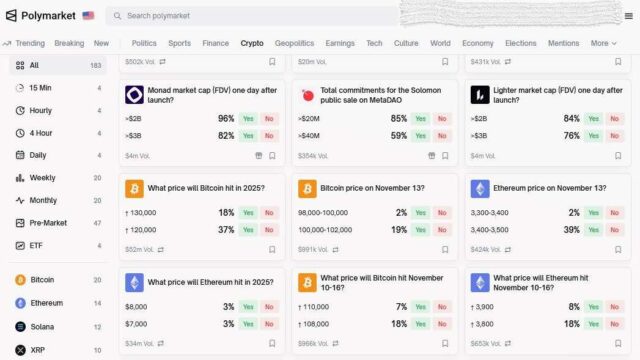
Polymarket’s return to the U.S. isn’t just about reopening a website for crypto-savvy traders. As the platform quietly onboards its first American users in a regulated beta, its odds are also heading to two far larger arenas: Google’s finance tools and mainstream sports apps. Google has begun surfacing prediction market prices from Polymarket and its regulated rival, Kalshi, directly in Search and Google Finance. It now treats event contracts as another piece of financial data.

At the same time, fantasy sports heavyweight PrizePicks is preparing to offer Polymarket-powered event contracts inside its app. The companies have a multi-year partnership pitched as “federally regulated” prediction markets for the DFS crowd. These integrations push Polymarket out of the crypto niche and into front-page consumer products. They also raise new questions about whether prediction odds are becoming a default signal for how people track politics, sports, and the economy.

What Exactly Relaunched: A Regulated, Limited U.S. Beta

Polymarket begins its U.S. relaunch with a quiet, tightly controlled beta. A small group of U.S. users can now access a regulated venue built on exchange and clearing infrastructure that Polymarket acquired earlier this year. This setup allows the company to list CFTC regulated event contracts without repeating the compliance lapses that led to its 2022 enforcement case.

The new environment introduces strict geofencing, full KYC, and clearer disclosures. Access remains limited, and many users still land on a waitlist as the company tests its onboarding flow. The firm has not disclosed a timeline for nationwide access. For now, Polymarket beta access remains invite-only.

Google Finance Integration Makes Prediction Odds Impossible to Ignore

Google’s move may prove even more significant than the beta itself. The company is now showing prediction odds from Polymarket and Kalshi directly in Search and Google Finance. Users who look up political events, inflation forecasts, or sports matchups can now view market-implied probabilities without leaving a familiar interface.

This is the moment where prediction markets like Polymarket shift from being a crypto curiosity to a standard financial signal. The integration, framed as Google Finance prediction data, treats event markets on par with indexes and commodities. That shift elevates prediction markets into tools used for everyday analysis rather than niche speculation.

For Polymarket, this visibility acts as distribution at massive scale. It also functions as an indirect endorsement that event markets deserve a place alongside polling averages and sentiment gauges.

PrizePicks Partnership: A Direct Pipeline to U.S. Sports Fans

If Google brings reach, PrizePicks brings users who already engage with data-driven sports formats. The partnership with PrizePicks creates a multi-year integration that embeds Polymarket’s regulated markets into one of America’s largest fantasy sports apps. PrizePicks will list event contracts covering sports, entertainment, and cultural moments. These contracts will flow directly from Polymarket’s regulated rails.

The important factor is the customer base. PrizePicks brings millions of verified U.S. users to this partnership. Users who are comfortable with mobile-first prediction mechanics. Adding event contracts to that environment removes the friction that usually slows Web3 adoption.

Unlike sportsbooks, PrizePicks does not need state-by-state gambling licenses for this product. The companies rely on federally regulated event contracts instead. This gives the integration a broader footprint than traditional betting apps, which must navigate a patchwork of state rules.

Polymarket Is Starting to Look More Like Infrastructure Than a Standalone App

Polymarket’s U.S. relaunch showcases a platform shifting from consumer app to distribution engine. The company now supplies markets and data feeds to partners boasting large audiences. It becomes both a venue and a back-end provider:

  • Venue: the regulated exchange that handles U.S. order flow
  • Infrastructure: an API layer that powers data platforms and consumer apps

This model positions Polymarket differently from Kalshi. Kalshi operates a traditional exchange with its own user-facing experience. Polymarket, in contrast, leans on partnerships that deliver its markets to users through familiar apps. That approach lets U.S. prediction markets spread through interfaces people already use daily.

Prediction Markets Are Following a Clear Path Into the Financial Mainstream

Several trends are converging. Public frustration with polling has pushed analysts to look for alternative signals. Retail users have become more comfortable with event-based forecasts through fantasy sports and mobile prediction tools. Venture capital firms continue to fund companies in the sector.

Interest in prediction markets has also increased as these products appear in apps people already trust. Users no longer need Web3 wallets or layered onboarding to interact with event-driven markets, lowering friction and broadening the appeal.

Major tech companies are also giving prediction data more visibility. This sets the stage for the mainstream adoption of prediction markets as part of standard financial and news consumption. Markets that once required wallets and stablecoins now appear in Google’s clean UI and inside popular sports apps.

The Polymarket U.S. relaunch is more than a regulatory milestone. It reflects a pivot toward mass distribution through partners with enormous reach. Google brings search visibility, while the PrizePicks partnership brings a base of engaged, mobile-first sports users. Together, they place prediction markets inside the everyday information stack.

If these trends continue, prediction odds could soon become as familiar as polling numbers or analyst forecasts; searchable, visible, and integrated into the tools Americans use to follow real-world events.

Readers’ frequently asked questions

Which U.S. states can currently access Polymarket’s regulated beta?

Polymarket has not published a state-by-state availability list. Access is limited to an invite-only group of U.S. users who pass KYC and meet the platform’s geofencing checks. The company says broader access will be rolled out only after its U.S. infrastructure completes phased regulatory and technical testing.

Does using Polymarket through PrizePicks require a cryptocurrency wallet?

No. PrizePicks will offer Polymarket-powered event contracts inside its existing app, using its standard account system. Users will not need a crypto wallet or on-chain interaction because the contracts are settled through Polymarket’s regulated backend.

How does Google decide which prediction market data to display in Search and Google Finance?

Google sources licensed feeds from regulated prediction platforms, including Polymarket and Kalshi. It displays market-implied probabilities for events that meet its data quality criteria and fall within categories it already tracks, such as politics, macroeconomic releases, and sports outcomes.

What Is In It For You? Action items you might want to consider

Track U.S. availability changes for Polymarket’s beta

Polymarket has not yet published a public rollout timeline. Users who want early access should monitor official announcements for new states and expanded eligibility.

Check whether PrizePicks enables prediction contracts in your region

PrizePicks will introduce Polymarket-powered event contracts on a jurisdiction-by-jurisdiction basis. Users should verify availability directly in the PrizePicks app as rollout may differ from standard DFS offerings.

Monitor Google’s coverage to see which event categories gain visibility

Google updates its prediction data surfaces as new feeds and categories meet its quality criteria. Tracking which Polymarket markets appear in Search and Google Finance can help users understand where mainstream adoption is growing fastest.

Circle Launches Arc Blockchain Testnet to Build a Regulated Infrastructure for Institutional Finance

TL;DR

  • The Arc blockchain testnet marks Circle’s evolution from a USDC issuer to an institutional infrastructure provider, with compliance and interoperability built at its core.
  • Major institutions including BlackRock, Goldman Sachs, Visa, Anthropic, and Elliptic are participating in the public testnet phase.
  • Arc is designed as a permissioned network for tokenized assets, integrating on-chain identity, analytics, and regulatory-grade governance for institutional adoption.

Circle, the issuer of USDC, has launched the Arc blockchain testnet. That’s a major step in its transformation from stablecoin provider to institutional infrastructure developer. The new permissioned Layer-1 network aims to serve specifically regulated financial institutions, embedding compliance, security, and interoperability into its core. With BlackRock, Goldman Sachs, Visa, Anthropic, and Elliptic among its first participants, Arc represents Circle’s most ambitious effort yet to bridge traditional finance and tokenized digital markets.

What Exactly Launched — Inside the Arc Blockchain Testnet

The Arc blockchain testnet, unveiled in late October 2025, opens Circle’s new institutional network for public experimentation. Developers, banks, and asset managers can now integrate, test, and validate transactions under regulatory-grade conditions.

Arc is powered by Circle’s Web3 Services stack, enabling native support for USDC, programmable payments, and tokenized asset issuance. Unlike open DeFi networks, Arc runs on a permissioned blockchain where access requires verified institutional identities.

Elliptic provides the compliance and analytics infrastructure underpinning Arc’s risk management and regulatory visibility. It ensures that AML and CTF checks are built directly into the network. Meanwhile, Anthropic contributes to the developer experience, supporting AI-assisted tools for smart contract deployment, debugging, and governance automation on Arc.

The Vision Behind Arc — A Blockchain Built for Compliance

Circle describes Arc as a regulated blockchain for tokenized assets. A network that mirrors the oversight of traditional finance while preserving blockchain’s speed and transparency. Compliance and KYC functions are integrated at the protocol level, not added later. Every transaction can be traced to verified entities operating under licensed frameworks, allowing institutions to move assets securely while satisfying AML and counterparty requirements.

This Arc blockchain for institutional finance aims to enable settlement of tokenized securities, fund shares, and digital cash equivalents on-chain. By aligning its architecture with financial regulations, Circle positions Arc alongside JPMorgan’s Onyx, Citi Token Services, and Avalanche Evergreen subnets, each competing to define the infrastructure layer of institutional DeFi.

Who’s Onboard — Institutions Powering the Testnet

Some of the world’s most influential organizations are already piloting Circle’s Arc network.

  • BlackRock and Goldman Sachs are reportedly testing settlement and fund-tokenization models on the Arc environment.
  • Visa is evaluating integrations that could link its payment rails to on-chain assets.
  • Anthropic focuses on improving developer workflows through AI-driven productivity tools.
  • Elliptic provides compliance and analytics infrastructure, ensuring that the Arc blockchain compliance framework meets global regulatory standards.

With BlackRock and Goldman testing the Arc network, Circle gains validation from partners whose participation signals trust in the network’s potential to host regulated financial activity at scale.

Why Arc Matters — Circle’s Bid to Redefine Digital Finance

For Circle, the Arc blockchain testnet represents more than technical progress; it’s a strategic repositioning. The company is evolving from managing a single stablecoin to offering infrastructure for digital finance itself. This move enables institutions to adopt blockchain tools without breaching compliance boundaries or relying on fragmented DeFi solutions.

Arc could become the institutional backbone for tokenized funds, payments, and settlements that meet the standards of global regulators. By prioritizing compliance, Circle differentiates its network from retail-oriented blockchains and strengthens its reputation as a trusted bridge between regulated finance and Web3.

The Bigger Picture — Tokenized Finance at an Inflection Point

Arc launches amid a surge of institutional experiments in tokenized finance. Governments and regulators across the U.S., U.K., and Europe are developing frameworks for regulated digital asset markets. At the same time, major banks deploy pilot networks for real-world assets (RWA) and instant settlement.

Within this movement, Circle’s Arc blockchain testnet offers a unified model where financial institutions, regulators, and technology providers operate in the same environment. Moreover, the initiative underscores the growing view that permissioned blockchains, not public DeFi platforms, may drive the next wave of enterprise adoption.

Circle’s launch of the Arc blockchain testnet positions the company at the forefront of the shift toward regulated on-chain infrastructure. The testnet will expand over the coming months as more partners and developers join. The mainnet launch is expected in 2026.

If successful, Arc could become the first network to bring regulatory compliance, institutional scale, and blockchain efficiency together, solidifying Circle’s infrastructure for digital finance and setting a new standard for how the global financial system operates on-chain.

Readers’ frequently asked questions

Can individual developers or small teams access the Arc testnet?

Yes. Although Arc will primarily serve institutional participants, Circle’s public testnet phase allows verified developers and partner organizations to experiment with integrations, smart contracts, and compliance APIs.

What differentiates Arc from other enterprise or permissioned blockchains?

Arc integrates compliance, identity verification, and analytics infrastructure directly at the protocol level. This built-in regulatory layer distinguishes it from generic permissioned chains that rely on external compliance add-ons.

Does participation in the Arc testnet require regulatory licensing?

Yes. Institutions and developers must undergo Circle’s verification process. Participants must comply with applicable financial regulations and KYC standards before receiving testnet access.

What Is In It For You? Action items you might want to consider

Monitor enterprise adoption milestones on the Arc network

Follow Circle’s developer updates and partner announcements to track which financial institutions move from testing to production. Early adoption trends may indicate Arc’s potential to become a core layer for institutional blockchain infrastructure.

Explore developer access requirements and onboarding options

If you’re a fintech builder or compliance technology provider, review Circle’s verification process and technical documentation to understand eligibility criteria for Arc’s permissioned environment.

Evaluate the emerging competition in institutional blockchain infrastructure

Compare Arc’s compliance-native model with frameworks such as JPMorgan Onyx, Citi Token Services, and Avalanche Evergreen to identify potential collaboration or integration opportunities.

SoFi Becomes First U.S. National Bank to Offer In-App Crypto Trading

TL;DR

  • SoFi crypto trading debuts inside the SoFi Bank app, marking the first U.S. bank to offer crypto trading under a national charter.
  • Launch covers Bitcoin (BTC), Ether (ETH), and Solana (SOL) with a phased rollout through early 2026.
  • CEO Anthony Noto, in public investor remarks, said the move is step one toward a SoFi USD stablecoin and deeper bank crypto integration in lending and payments.

SoFi Crypto has launched at SoFi Bank, N.A., making the institution the first U.S. bank to offer crypto trading directly inside its mobile app.

The new feature lets customers buy, sell, and hold Bitcoin, Ether, and Solana from their existing SoFi accounts without using a separate exchange. Overall, this in-app crypto trading rollout, announced in November 2025, marks a turning point for regulated banking participation in digital assets.

What Exactly Launched

Branded as SoFi Crypto, the service allows verified retail clients to buy, sell, and hold crypto within the SoFi Bank ecosystem. Users can fund transactions instantly from SoFi checking or savings balances, with balances visible alongside traditional accounts. The SoFi Crypto launch began with BTC, ETH, and SOL. More assets will follow in phases. Meanwhile, a waitlist ensures a gradual onboarding across eligible states, and early adopters can earn promotional Bitcoin rewards.

SoFi emphasizes that all crypto balances are custodied by SoFi Digital Assets LLC, a non-bank subsidiary, and are not FDIC-insured deposits, even if accessed through the same app interface. This structure keeps customer funds under clear regulatory separation while offering a unified app experience.

Why It Matters for U.S. Banking

This launch cements SoFi’s position as the first nationally chartered bank to offer crypto trading to retail customers under OCC oversight. Previously, U.S. banks could provide crypto access only through third-party platforms or custodial partners.

However, that changed after the OCC released new crypto guidance this summer. Though not a direct approval, the regulator enabled banks, explaining how they can integrate digital-asset services safely. The new framework clarified expectations on capital, custody, and risk management. As SoFi has already held a national bank charter since 2022, it could act quickly once these rules were published. Consequently, SoFi bridged fintech agility and traditional bank governance.

How SoFi Positions Itself

CEO Anthony Noto said the initiative proves that “banking and crypto can coexist responsibly inside one trusted platform.” The company, therefore, emphasizes bank-grade security and compliance. That includes multi-factor authentication, transaction monitoring, and segregated custody via SoFi Digital Assets LLC.

For users, the appeal is simplicity and speed. The SoFi app now manages checking, savings, investing, and crypto trading within the same platform. SoFi’s seven-million-member base, largely composed of tech-savvy millennials, fits the target demographic. Furthermore, the app includes tutorials and “learn before you trade” modules to help users understand the basics of blockchain and its risks. As a result, customers can make informed decisions before buying crypto.

Risk and Regulatory Disclosure

Even though SoFi Bank is FDIC-insured, its crypto service sits outside this deposit protection. All digital-asset balances are held by SoFi Digital Assets LLC and follow separate terms of service.

Every trading screen reminds customers that crypto is not FDIC-insured and that prices can fluctuate sharply. Moreover, SoFi’s educational hub explains volatility, custody, and loss scenarios in plain language. Therefore, the initiative aligns with regulators’ calls for transparency and consumer education.

Competitive Landscape

Meanwhile, most traditional banks remain cautious. Many are waiting for further clarity or testing pilot programs under supervision. Brokerages such as Schwab and Morgan Stanley have discussed digital-asset access but have not yet opened trading to retail users.

By contrast, SoFi’s national bank charter gives it a strategic edge over fintech rivals such as Revolut or Robinhood, which operate under money-transmitter rules. Thus, its approach demonstrates that full-service banks can now offer crypto trading under existing law. As a result, this first-mover advantage could encourage others to follow as confidence in regulatory enablement grows.

Roadmap and Future Plans

In public remarks at the KBW Fintech and Payments Conference 2025 and in SoFi’s official press release, Noto outlined a roadmap featuring a SoFi USD stablecoin. The coin would support payments and settlement functions and extend SoFi’s bank-grade infrastructure into the blockchain space. He also said the initiative remains subject to further regulatory review.

In addition, SoFi is exploring tokenized-deposit infrastructure to simplify transfers between consumer and enterprise accounts. Moreover, these projects form part of SoFi’s broader bank crypto integration strategy. It’s applying blockchain rails to modernize money movement while maintaining strong oversight. Ultimately, they signal a clear ambition to merge compliance, innovation, and scale.

Industry Implications

Consequently, SoFi’s launch shows that a bank can participate in crypto markets without compromising on prudential rules. For regulators, it provides a live example of how crypto guidance can foster compliant innovation. For competitors, it raises expectations to offer similar features or risk losing younger, digitally inclined clients. In addition, analysts already view SoFi’s model as a blueprint for merging regulated banking with digital-asset access. Therefore, the event marks an important step toward normalizing crypto inside U.S. financial institutions.

By launching SoFi crypto trading, the company has redrawn the line between banks and crypto platforms. As the first U.S. bank to offer crypto trading, SoFi proved that a nationally chartered, FDIC-insured institution can merge compliance and innovation, while keeping crypto custody in a non-bank subsidiary. Ultimately, the launch signals a broader wave of bank crypto integration that is pushing digital assets further into mainstream finance under clearer regulatory guidance.

Readers’ frequently asked questions

Who is eligible to use SoFi Crypto at launch?

Access is rolling out in phases to verified U.S. customers who have eligible SoFi Bank accounts and complete KYC. Availability may vary by state. A waitlist manages onboarding; the crypto option appears in-app once access is enabled.

How are taxes handled when trading crypto through SoFi?

SoFi provides annual tax documents summarizing crypto transactions to help users report capital gains or losses. Customers can download Form 1099-B or equivalent statements directly from the app at tax time. SoFi does not provide tax advice, and users remain responsible for their own filings.

What should I know about fees, limits, and funding?

SoFi shows any applicable pricing, spreads, and limits before you confirm an order. Funding from SoFi checking or savings is instant for eligible customers. Minimum trade sizes and daily limits are shown in-app and can vary by asset, user profile, and rollout phase.

What is in it for you? Action items you might want to consider

Review eligibility and onboarding status

Check whether your SoFi Bank account is eligible for crypto trading and complete the required KYC process. If the feature is not yet visible in your app, join the waitlist to receive access as the rollout expands.

Evaluate risk and tax responsibilities

Understand that crypto assets are not FDIC or SIPC insured and may fluctuate in value. Review SoFi’s disclosures carefully and download Form 1099-B or equivalent records at tax time to meet your reporting obligations.

Stay informed on future features

Follow SoFi’s official updates for new crypto assets, stablecoin developments, or lending features. Monitoring announcements can help you plan for upcoming functionality and compliance changes affecting U.S. bank–issued digital assets.

CleanSpark Raises $1.15 Billion to Expand Bitcoin and AI Computing Power

Editorial illustration of a CleanSpark data center merging Bitcoin mining and AI servers after $1.15 billion convertible notes raise.

TL;DR

  • CleanSpark convertible notes raise $1.15 billion with no interest payments to fund AI-ready data centers.
  • About $460 million will go toward a share buyback; the rest fuels expansion and debt reduction.
  • CleanSpark can redeem the notes from 2029 if its stock trades around $24.91 (130% of the conversion price).
  • The company is repositioning from a Bitcoin miner into a broader AI and compute infrastructure provider.

CleanSpark Inc (NASDAQ: CLSK) is taking a bold step to grow beyond Bitcoin mining. The company has raised $1.15 billion through convertible notes, a type of loan investors can later turn into company shares, to finance new AI-ready data centers and energy infrastructure across the United States.

This CleanSpark convertible notes deal, which carries no interest payments until 2032, highlights how mining firms are using Wall Street funding to pivot toward artificial intelligence and high-performance computing (HPC).

How the Financing Works

These 0% notes act as a flexible loan. Investors lend CleanSpark money now and can later convert that debt into shares if the stock price rises above a set level. The notes mature in February 2032 and can be converted into shares at $19.16 each. That’s roughly 27% higher than the company’s stock price when the deal was announced.

CleanSpark also offered an additional $150 million option for investors, which could lift the total deal size to $1.3 billion. This structure lets CleanSpark raise large-scale funding without paying interest each year, which keeps short-term costs low while betting on long-term stock growth.

Where the Money Will Go

The company plans to use $460 million of the funds to buy back its own stock at $15.03 per share, limiting dilution for existing shareholders. The rest, about $670 to $820 million, will be invested in growth projects:

  • Expanding its power and land portfolio to support more data centers.
  • Building HPC / AI data centers that can handle GPU-based computing, similar to the servers used for training large AI models.
  • Paying down earlier loans backed by its Bitcoin reserves.
  • General infrastructure spending.

In simple terms: part of the new cash keeps investors happy in the short run, and part funds CleanSpark’s long-term expansion into AI computing.

Why AI Matters for Bitcoin Miners

Bitcoin mining uses large amounts of energy and computing power. Think of it as operating fleets of digital “supercomputers” that verify transactions and earn rewards in Bitcoin. CleanSpark already runs one of the largest such fleets in North America.

But mining is becoming harder and less profitable as competition rises. To stay ahead, CleanSpark is repurposing part of its energy capacity to host AI and high-performance computing clients. That can generate a steadier income than mining alone. Other miners, like Iris Energy and Core Scientific, are doing the same. They are turning their massive power access into data centers that rent computing time to AI developers.

How the Market Reacted

Right after the announcement, CLSK shares fell about 5% in pre-market trading. This drop wasn’t necessarily a vote of no confidence; it’s a common effect when companies issue convertible notes.

Here’s why: some investors hedge by short-selling the stock to balance their risk, temporarily pushing the price down. Analysts said the deal’s zero-interest structure saves CleanSpark money now but could lead to new shares later if the price climbs above $19.16.

The Bigger Picture

Once completed, this financing will give CleanSpark more than $1 billion in new funding. The company expects to finalize the deal by November 13, 2025.

Starting in 2029, CleanSpark can buy back (or “redeem”) the notes if its stock price stays at 130% of the conversion level, about $24.91 per share, for several weeks. By then, its new data centers could be running both Bitcoin mining and AI workloads, positioning it as one of the first hybrid crypto-and-compute companies.

Outlook: From Miner to Infrastructure Provider

The CleanSpark convertible notes deal is more than a capital raise, it’s a strategic shift. By using investor loans that can turn into shares, CleanSpark avoids immediate debt pressure while betting on future growth from AI hosting.

In effect, the company is turning its energy-intensive Bitcoin mining operations into an all-purpose digital infrastructure network. If AI demand continues to surge, CleanSpark’s early move could pay off far beyond the next Bitcoin halving.

Readers’ frequently asked questions

What happens to CleanSpark’s stock if the notes are converted into shares later on?

If the share price rises above the $19.16 conversion level, noteholders may choose to convert their notes into equity. This would increase the number of shares outstanding at that time, potentially diluting existing holdings. However, until conversion, the share count does not change.

Why are Bitcoin mining companies turning to convertible notes instead of traditional loans?

Convertible notes let companies raise large amounts of capital without paying ongoing interest, preserving cash during tight-margin periods. Investors accept this because they gain potential upside if the stock performs well and they later convert into shares.

How could CleanSpark’s expansion into AI computing affect its long-term risk profile?

Diversifying into AI and high-performance computing spreads risk beyond Bitcoin mining’s price cycles. Revenue from data-center clients can be steadier than mining rewards, potentially making overall cash flows less volatile over time.

What Is In It For You? Action items you might want to consider

Track CleanSpark’s AI infrastructure rollout

Follow progress on CleanSpark’s new AI and high-performance computing (HPC) facilities. These developments will show how effectively the company transforms its Bitcoin mining capacity into diversified, long-term revenue sources.

Watch for signs of conversion activity

Keep an eye on CleanSpark’s stock price relative to the $19.16 conversion level. If shares approach or surpass that mark, noteholders could begin converting debt into stock, a move that may affect market supply and investor sentiment.

Compare financing strategies among miners

Other Bitcoin miners, such as Iris Energy and Core Scientific, are also using convertible debt to fund growth. Comparing their deal structures, conversion prices, and expansion results can help gauge which miners adapt best to the new AI-driven market cycle.

From Listings to Launches: Coinbase Moves Upstream With a Regulated Token-Sales Platform

Coinbase has launched a token-sales platform that lets users request allocations for new digital assets before they list on the exchange. The first offering features the Monad (MON) token. It marks the first major effort by a U.S.-regulated exchange to reopen public token sales for ordinary investors since the 2018 crackdown on unregistered offerings.

A Short History: What Disappeared After 2018

During the 2017–2018 ICO boom, thousands of crypto projects raised funds directly from the public. Most sales occurred without registration or oversight. After regulators intervened, exchanges stopped hosting those sales. As a result, U.S. retail investors lost access to early-stage token launches. Fundraising continued overseas, but participation was limited to private rounds and accredited buyers. Coinbase now aims to restore retail access within a regulated framework rather than revive the chaos of the ICO era.

How Coinbase’s Token-Sales Platform Works

Each sale on the Coinbase token-sales platform runs for a one-week request window. Users commit USDC, and when the window closes an algorithmic allocation system distributes tokens from smaller requests upward. The method favors broader participation instead of size or speed. Coinbase plans about one sale every month under its Coinbase token sales program. Each asset launched through the program will later appear on the Coinbase listings roadmap.

Guardrails to Limit Speculation

To discourage fast flips, Coinbase applies anti-flip rules that reduce allocation priority for traders who sell their tokens within 30 days. Project teams also face a six-month issuer lockup on secondary or over-the-counter sales unless Coinbase explicitly approves them. Issuers must publish tokenomics, team details, and supply data. Coinbase reviews every sale before listing to ensure transparency and compliance. These steps are designed to prevent the hype cycles that defined earlier token launches.

The Monad Token Sale

The debut sale features Monad, a high-performance layer-1 network backed by Paradigm and Coinbase Ventures. According to project documentation, up to 7.5 billion MON (about 7.5 percent of the initial supply) will be sold at $0.025 per token. Distribution will align with the project’s mainnet launch. Some reports initially misnamed “Monad” as the new platform. In fact, Coinbase Token Sales is the platform, and Monad is simply the first project offered.

Why Coinbase Is Moving Upstream

By running new sales directly, Coinbase is expanding upstream into primary token offerings. Until now, the company focused mainly on listings and secondary trading. This shift builds on its Echo acquisition, which added public-sale infrastructure later folded into the platform. The strategy could diversify revenue and deepen issuer relationships. However, it also places Coinbase inside a regulatory gray area that still draws close scrutiny.

Access—But Still Restricted

Coinbase describes the rollout as the broadest U.S. retail crypto access to token launches in years. Even so, participation remains limited to “select jurisdictions.” Eligibility will vary by region, and each sale includes its own compliance disclosures. In practice, Coinbase is not reviving the ICO model. Rather, it is testing a regulated channel for public participation under controlled conditions.

What to Watch Next

The coming months will show whether Coinbase can maintain compliance while scaling its Coinbase token sales cadence. Observers will watch how the allocation algorithm handles demand and how liquidity behaves after listings. It will also matter whether anti-flip rules encourage long-term holders. If the Monad token sale proceeds smoothly, Coinbase’s model could become a blueprint for future exchange-run primary markets in the United States and strengthen the case for continued Coinbase token sales on a monthly rhythm.

Readers’ frequently asked questions

Are Coinbase token sales available in all U.S. states?

Not yet. Coinbase token sales are accessible only in jurisdictions where Coinbase holds the necessary regulatory approvals. Certain U.S. states still restrict token sales under securities or money-transmission laws. Each sale page specifies the regions where participation is permitted.

How does Coinbase ensure token listings comply with U.S. regulations?

Before any sale, Coinbase’s compliance and legal teams review the token’s structure, issuer disclosures, and lockup arrangements. Tokens cleared for sale appear on the Coinbase listings roadmap and undergo further review before trading begins on the exchange.

What happens if a token fails to meet listing or regulatory conditions after the sale?

If a project fails to meet Coinbase’s or regulators’ post-sale conditions, the exchange can postpone or cancel the listing. In such cases, buyers receive refunds in USDC, as stated in Coinbase’s token-sale terms.

What Is In It For You? Action items you might want to consider

Check eligibility and KYC early

Confirm that your location is supported and your account is verified. Since sales are jurisdiction-dependent and time-boxed, resolving KYC issues in advance helps secure an allocation.

Prepare USDC and a funding plan

Allocations are requested in USDC. Decide on a maximum commitment per sale and avoid over-allocating; the algorithm favors smaller requests to broaden participation.

Review issuer disclosures and lockups

Read the project’s tokenomics, supply schedule, and lockup terms. Note that issuers face a six-month restriction and that buyers who flip quickly may be de-prioritized in future sales.

- Advertisement -

FEATURED