Home Blog Page 92

Thailand Pitches Crypto Payments to Tourists in Bid for Regional Edge

Tourist in Thailand using a crypto wallet app to convert Bitcoin, Ethereum, and Tether into Thai baht for spending during travel.

Thailand has launched a crypto wallet pilot that allows foreign tourists to convert Bitcoin, Ethereum, and stablecoins into Thai baht. The initiative positions the country at the crossroads of tourism and fintech innovation, while regional rivals Singapore and Hong Kong take different approaches to crypto adoption.

How the Tourist Wallet Works

Thailand’s new tourist crypto wallet enables visitors to convert digital assets such as Bitcoin, Ethereum, and Tether into baht for use at local businesses. Transactions do not occur in crypto directly; instead, the wallet provides crypto-to-baht payments through regulated exchanges.

Supported assets include Bitcoin and Ethereum, with additional stablecoins offered for convenience. By focusing on conversion rather than merchant-level crypto acceptance, the government ensures that payments remain compliant with existing financial rules.

Tourism as a Testing Ground

Tourism accounts for nearly one-fifth of Thailand’s GDP, making it a natural sector to trial digital finance tools. The Thailand crypto tourism initiative is designed to attract high-spending, crypto-savvy travelers who want to spend their assets abroad without costly conversions or intermediaries.

By linking digital assets with travel, Thailand is experimenting with a model that could give it an advantage in capturing a younger generation of digital-native tourists. The pilot also signals that Thailand’s tourist crypto wallet solutions could be expanded if demand proves strong.

Sandbox Constraints & Regulatory Oversight

Despite the excitement, the program is still confined to a Thailand tourism sandbox. The Bank of Thailand and the Securities and Exchange Commission are overseeing the 18-month pilot, which includes strict compliance checks and limits on transaction volumes.

Officials stress that the wallet is not a path to recognizing cryptocurrency as legal tender, but rather a controlled framework within Thailand’s cryptocurrency regulation. The pilot highlights a cautious but forward-looking approach to integrating digital assets.

Regional Context: Competing with Singapore & Hong Kong

Thailand’s move comes as crypto adoption in Southeast Asia accelerates. Singapore has maintained a tighter stance on retail crypto use, while Hong Kong has leaned into pro-crypto licensing frameworks. By targeting the tourism sector, Thailand is carving out a distinct niche, turning travel into a proving ground for digital asset payments.

This strategy reflects the country’s ambition to blend its tourism strengths with emerging fintech opportunities.

Lessons from Bhutan’s Bold Experiment

Earlier this year, Bhutan launched the world’s first national crypto tourism payment system, developed with Binance Pay and DK Bank. Unlike Thailand’s cautious pilot, Bhutan’s model allows tourists to pay directly in over 100 cryptocurrencies, with merchants instantly receiving local currency settlement in ngultrum.

  • Scale: Bhutan’s system is nationwide, while Thailand limited its pilot to a sandbox.
  • Transaction flow: Bhutan enables direct crypto payments, Thailand requires conversion to baht before spending.
  • Adoption: Bhutan has already onboarded more than 1,000 merchants, from hotels to souvenir shops. Thailand’s rollout is restricted to controlled participants.
  • Strategy: Bhutan integrates crypto deeply into its economic model, tying it to state-backed mining and reserves. Thailand’s initiative is narrower, focused mainly on boosting its tourism appeal.

Taken together, Bhutan’s approach shows the opposite end of the spectrum. While Bhutan is embracing direct crypto usage, Thailand is testing crypto-to-baht payments as a safer, regulator-approved pathway.

Industry & Market Reactions

Market observers have mixed reactions. Optimists believe the program could help Thailand position itself as a leader in crypto-friendly tourism, drawing in both travelers and fintech startups. Critics caution that volatility in crypto markets and the sandbox’s strict conditions may limit real-world adoption.

From the perspective of the travel industry, however, even a limited wallet rollout adds appeal for younger visitors who already use crypto in their daily lives. The framing of Thailand’s crypto tourism as an innovation testbed could also appeal to policymakers and investors watching the sector.

Outlook: From Sandbox to Strategy

If successful, the tourist wallet could serve as a blueprint for broader crypto-to-baht payments in other areas of the economy. Policymakers may consider integrating lessons learned into future financial frameworks, possibly aligning with Thailand’s ongoing digital baht pilot.

For now, the program remains a test. But its long-term potential lies in shaping how Thailand uses tourism to accelerate digital finance innovation.

Thailand’s tourist crypto wallet is more than a payment tool; it is a signal of intent. By combining Thailand’s crypto tourism with strict oversight, the country is positioning itself as a bridge between innovation and regulation. Bhutan’s all-in approach may offer inspiration, but Thailand’s measured rollout reflects a strategy of balancing opportunity with caution.

Readers’ frequently asked questions

Do tourists need to open a Thai bank account to use the tourist crypto wallet?

No. The wallet is designed for short-term visitors and works independently of local bank accounts.

How do tourists top up the wallet with crypto before converting to baht?

Tourists can transfer supported cryptocurrencies from their personal wallets or exchange accounts into the designated tourist wallet app, where the funds are then converted into baht.

Is the tourist crypto wallet available to Thai residents?

No. The program is limited to foreign visitors only, as it is part of a tourism-specific pilot program.

What Is In It For You? Action items you might want to consider

Follow the tourist wallet rollout

If you’re a crypto investor or frequent traveler, monitor how the Thailand tourist crypto wallet develops during the sandbox phase. Its success or failure may influence future crypto payment pilots in the region.

Track Southeast Asia’s crypto tourism competition

Thailand’s cautious pilot contrasts with Bhutan’s full-scale launch and Hong Kong’s licensing regime. Traders and entrepreneurs should evaluate how different jurisdictions are positioning themselves in the crypto-tourism space.

Assess business opportunities in crypto travel payments

Merchants, fintech startups, and payment providers could benefit from integrating crypto-friendly services that align with regulated pilots like Thailand’s. Consider how your business might adapt to serve crypto-savvy travelers.


Gemini IPO Filing Highlights Financial Risks Amid $282M Loss in 2025

Photo-realistic image showing two suited businessmen resembling the Winklevoss twins walking toward a modern glass office tower in New York City, with reflections of digital financial charts on the building and subtle blockchain symbols etched into the architecture, symbolizing Gemini's IPO and crypto market legitimacy.

Gemini, the cryptocurrency exchange founded by Cameron and Tyler Winklevoss, has filed for a public listing on Nasdaq under the ticker GEMI. The move marks one of the boldest attempts by a U.S. crypto exchange to enter Wall Street since Coinbase went public in 2021. But the filing also casts a shadow over Gemini’s financial health. Shrinking revenue and a net loss of more than $282 million in 2025 underscore the financial risks investors must weigh when evaluating the Gemini IPO.

IPO Filing Details

Gemini first made headlines in June 2025, when reports confirmed the company had confidentially submitted a draft S-1 registration to the Securities and Exchange Commission (SEC). On August 15, that confidential filing was made public, confirming Gemini’s intent to pursue a Nasdaq listing under the GEMI ticker.

While the public filing did not disclose a valuation target, the move signals Gemini’s determination to bring another U.S.-based crypto exchange into the public market despite ongoing challenges.

Gemini’s Financial Performance

According to the IPO documents, Gemini reported a notable revenue decline in the first half of 2025. At the same time, its net losses surged to approximately $282 million, far outpacing previous years.

The company attributed the losses to shrinking trading activity, mounting compliance costs, and expenses tied to legal battles. These figures put the exchange at a sharp disadvantage compared to rivals. They also highlight the financial risks behind Gemini’s IPO ambitions.

Gemini continues to face scrutiny from U.S. regulators. While it has already settled cases with New York authorities, agreeing to return more than $1 billion to Earn customers and pay fines, the federal SEC lawsuit over the Earn program remains unresolved. That case, filed in January 2023, has been temporarily paused in 2025 as both sides explore a potential settlement. These unresolved issues keep regulatory risk at the center of Gemini’s IPO story.

The company has restructured parts of its operations to improve compliance. Still, these disputes remain a significant drag on investor confidence.

Market Context

The IPO attempt comes amid a crypto market rebound in 2025. Bitcoin and Ethereum have rallied, rekindling interest in digital asset firms. Gemini appears to be capitalizing on the optimism, even as its financials raise red flags.

Comparison With Rivals

Gemini’s Nasdaq filing will inevitably be compared to Coinbase’s 2021 IPO, which briefly valued that company at nearly $100 billion. By contrast, Gemini has a far smaller trading footprint and weaker brand recognition. That smaller scale could magnify the financial risks investors see in its Nasdaq debut.

Risks and Investor Concerns

  • Financial fragility: steepening losses and falling revenue.
  • Regulatory battles: ongoing lawsuits tied to Earn and state-level investigations.
  • Competitive disadvantage: far behind Coinbase and Binance in volume and scale.

These headwinds frame Gemini as a risk-heavy entrant to public markets.

Outlook

Gemini has not disclosed how much capital it hopes to raise through the IPO. The outcome will be an important test of whether investors are willing to look past financial risks and regulatory uncertainty. For some, GEMI will represent exposure to a U.S. crypto exchange. For others, it will remain a speculative bet.

The financial risks revealed in Gemini’s IPO filing highlight a tension at the heart of crypto’s Wall Street ambitions. A Nasdaq listing would mark a milestone for the Winklevoss twins’ platform. Yet shrinking revenue and a $282 million loss in 2025 make GEMI a high-stakes bet. Investors must weigh whether the listing is a chance to back crypto’s growth or a warning sign of an exchange under pressure.

Readers’ frequently asked questions

What does it mean that Gemini filed a confidential S-1?

A confidential S-1 is an initial draft of a company’s IPO registration statement that is submitted to the SEC but not immediately made public. It allows the SEC to review the filing and provide feedback before investors see the details. Gemini first made such a confidential filing in June 2025, before releasing the public version in August.

What is the significance of the GEMI ticker?

GEMI will be Gemini’s ticker symbol if the IPO proceeds. Investors will use this symbol to trade shares of Gemini on the Nasdaq exchange. It serves as the company’s identifier in public markets, similar to COIN for Coinbase.

Does Gemini’s IPO change anything for existing Gemini exchange users?

No. Through this IPO, the company offers shares to public investors. It does not affect customer accounts, trading balances, or access to Gemini’s platform. Users can continue to buy, sell, and hold crypto on Gemini as before.

What Is In It For You? Action items you might want to consider

Track investor appetite for crypto IPOs

Wall Street will watch Gemini’s filing closely. Traders and analysts should monitor how investors respond, as it may set the tone for future crypto exchange listings.

Watch for Gemini’s regulatory outcomes

The IPO process will keep Gemini’s legal battles and the corresponding risks in the spotlight. Following developments in its disputes with the SEC and the New York Attorney General can help gauge the company’s long-term viability.

Compare Gemini’s valuation to Coinbase’s precedent

If valuation targets are disclosed, comparing Gemini to Coinbase’s IPO can offer insights into how markets price smaller, riskier exchanges. This benchmark could influence investment strategies in the sector.

European Blockchain Convention 2025

Views of Park Guell, Barcelona. The city will host the European Blockchain Convention 2025.

This October, the European Blockchain Convention returns to Barcelona for its most dynamic experience yet: more content, more stages, and more curated spaces for networking. The two-day event will bring together over 6,000 attendees, including builders, founders, investors, and stakeholders from various sectors, to discuss the growth and future of blockchain.

What’s New in EBC 2025

  • Three Stages

This year, the European Blockchain Convention introduces a third stage for more sessions with thought leaders. EBC 2025 features over 300 speakers, including:

  • Christopher Perkins, President, CoinFund
  • Anthony Scaramucci, Founder & Managing Partner, SkyBridge Capital
  • Erald Ghoos, CEO Europe, OKX
  • Coty de Monteverde, Head of Crypto & Blockchain Center, Banco Santander
  • Emma Lovett, Executive Director – Markets Digital Assets, J.P. Morgan
  • Robby Yung, CEO for Investments, Animoca Brands
  • Staci Warden, CEO, Algorand Foundation
  • Stephan Lutz, CEO, BitMEX
  • Expanded Exhibition

A 3,000 m2 exhibition space, giving more room to explore groundbreaking technologies, engage with leading companies, and discover new blockchain infrastructure shaping the future of finance and technology.

  • Deal-Focused Venue

The entire layout of the European Blockchain Convention 2025 is designed to make businesses happen. From lounge areas to networking zones, the event is built to facilitate strategic partnerships and connections.

  • App-Powered 1:1 Meetings

The European Blockchain Convention app 2025 allows browsing of attendees and scheduling one-on-one meetings in advance.

  • LP Breakfast

An exclusive breakfast session bringing together top allocators, asset managers, hedge funds, banks, and high-net-worth individuals.

  • Startup Battle

Europe’s most promising blockchain startups will pitch live for a chance to win funding from EBC sponsors and investors present.

  • Private Roundtables

EBC Barcelona 2025 includes private roundtables for direct, meaningful exchanges with industry peers.

  • Mentoring Sessions with Industry Veterans

One-on-one and small-group mentoring from industry leaders. The European Blockchain Convention 2025 provides opportunities for founders to receive guidance from experienced industry experts.

  • Press Room

A new press lounge, providing media professionals with direct access to speakers and VIPs.

  • Higher-Quality Side Events

This year’s side events are carefully curated for maximum relevance and value. Each one is designed to foster high-quality interactions, with an emphasis on meaningful networking rather than volume.

Who Should Attend the European Blockchain Convention 2025?

  • Blockchain and Web3 founders
  • Institutional investors (VCs, hedge funds, private equity)
  • Banks, asset managers, and financial institutions
  • Regulators, policymakers, and compliance experts
  • Corporate strategists, and tech leaders
  • Developers, engineers, and product teams
  • Media, academics, and analysts

Venue and Registration

When: 16 – 17 October 2025
Where: Fira Barcelona Montjuic, Barcelona, Spain
Tickets: Available in three tiers- General Pass, VIP, and Tiger Pass

Since its inception in 2018, the European Blockchain Convention has offered a vibrant platform where stakeholders in the blockchain and Web3 spaces come together to connect, learn, and collaborate. The 2025 Barcelona edition promises to be bigger, bolder, and more influential than ever, focusing on quality rather than volume.  For information on ticketing and other details, visit European Blockchain Convention 2025.

U.S. Sanctions Garantex and Grinex, Offers $6 Million Bounty in Russian Crypto Crackdown

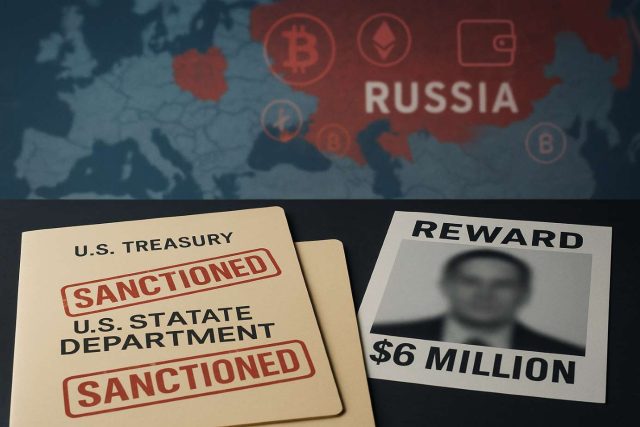
U.S. Treasury and State Department folders marked “Sanctioned” with a $6 million reward notice, set against a blurred map of Russia and cryptocurrency icons, symbolizing sanctions on Garantex and Grinex.

The United States has intensified its campaign against illicit Russian cryptocurrency activity. It re-designated Garantex under new sanctions and blacklisted its alleged successor Grinex. The U.S. State Department also announced a $6 million bounty for information leading to the arrest or conviction of Garantex’s leadership. Authorities say both exchanges played a central role in ransomware laundering and darknet market transactions. These activities violate U.S. sanctions enforced by the Treasury’s Office of Foreign Assets Control (OFAC) against cryptocurrency exchanges.

Garantex’s Troubled History

Founded in Moscow, Garantex operated as a major trading hub for ruble-denominated digital assets. The platform was first sanctioned in 2022 after U.S. investigators linked it to more than $100 million in illicit transactions. These included payments tied to ransomware groups like Ryuk and Conti. Hydra and other darknet marketplaces also used the exchange.

According to the U.S. Treasury’s Office of Foreign Assets Control (OFAC), Garantex acted as a gateway for converting cryptocurrency from criminal activities into fiat currency. This undermined global sanctions enforcement.

Grinex: The Alleged Successor

The newly sanctioned Grinex exchange is accused of acting as a contingency plan crypto exchange for Garantex. Investigators say it inherited its infrastructure, user base, and operational methods. OFAC alleges that Grinex continued the same illicit services while bypassing restrictions from earlier sanctions. The case shows how sanctions are evaded through rebranded entities that look legitimate but are run by the same individuals or networks.

The $6 Million Garantex Bounty

In a parallel move, the State Department’s Rewards for Justice program is offering a bounty of up to $6 million for credible information on Garantex leadership. The reward applies to tips leading to arrest, conviction, or disruption of the network. Similar bounties have been used in past cybercrime cases. They have helped target ransomware operators and their enablers. Washington says the measure underscores its determination to dismantle these ecosystems.

Cybercrime and Ransomware Disruption

Exchanges like Garantex and Grinex serve as financial lifelines for ransomware operations. Victims often pay attackers in cryptocurrency. That money is then routed through such platforms to obscure its origin.

These exchanges help criminals launder ransomware payments through cryptocurrency channels, converting them into cash without alerting traditional banking systems. U.S. authorities believe that cutting off these laundering channels is critical to disrupting major ransomware operations.

Sanctions Policy and Compliance Risks

The re-designation of Garantex highlights OFAC’s approach to tightening enforcement through follow-up action, targeting sanctioned entities that continue operations. The inclusion of Grinex sends a warning to the industry that successor exchanges are not beyond reach.

The Treasury also sanctioned wallets tied to a ruble-backed stablecoin known as the A7A5 token, citing its role in sanctions evasion. For legitimate crypto businesses, this reinforces the need for robust sanctions compliance programs to avoid engagement with blacklisted counterparties.

Global and Industry Reactions

There has been no public response from Russian authorities. Compliance experts say the measures will likely limit these exchanges’ access to international liquidity. Some exchanges outside Russia may now review their exposure to ruble-linked assets and reassess their customer due diligence processes.

The move signals to other jurisdictions that the U.S. won’t shy away from taking aggressive action against cross-border sanctions evasion through crypto schemes.

What’s Next

Officials say investigations into both exchanges are ongoing. More sanctions could follow against connected wallets, mixers, or service providers. Analysts warn that the same operators may attempt to launch another replacement platform. This makes vigilance essential.

The broader strategy, combining direct enforcement with financial isolation, will likely remain central to U.S. cybercrime policy.

The coordinated targeting of Garantex and Grinex marks a decisive escalation in U.S. efforts to curb illicit crypto flows linked to Russia. By coupling financial isolation through Garantex sanctions with a multi-million-dollar bounty on its leadership, Washington sends a clear message. The infrastructure that enables cybercrime and disruption will face relentless pressure, no matter how many times it changes its name.

Readers’ frequently asked questions

How can someone provide information to claim the $6 million bounty?

Tips can be submitted through the U.S. State Department’s Rewards for Justice secure online form or via regional U.S. embassy contacts. The program also offers channels for encrypted or anonymous communication.

What are the potential consequences for foreign exchanges that process transactions linked to sanctioned entities?

Such exchanges risk being added to OFAC’s Specially Designated Nationals (SDN) list, which can cut them off from the U.S. financial system, limit their international partnerships, and expose them to secondary sanctions.

Authorities use blockchain forensics, transaction pattern analysis, shared infrastructure identifiers (like wallet clusters), and intelligence from cooperating jurisdictions to trace operational continuity between entities.

What Is In It For You? Action items you might want to consider

Review your exchange’s compliance protocols

If you operate or trade through a crypto exchange, ensure it has robust sanctions screening tools in place to block transactions involving OFAC-listed entities and wallet addresses.

Monitor OFAC updates and SDN list changes

Stay informed on the U.S. Treasury’s sanctions announcements, especially new additions to the Specially Designated Nationals list, to avoid indirect exposure to blacklisted platforms.

Use blockchain analytics to assess counterparty risk

Leverage blockchain intelligence services to identify links between counterparties and sanctioned entities, including potential successor exchanges attempting to evade restrictions.

SPAR Switzerland Crypto Payments Expand to 300 Stores in Nationwide Rollout

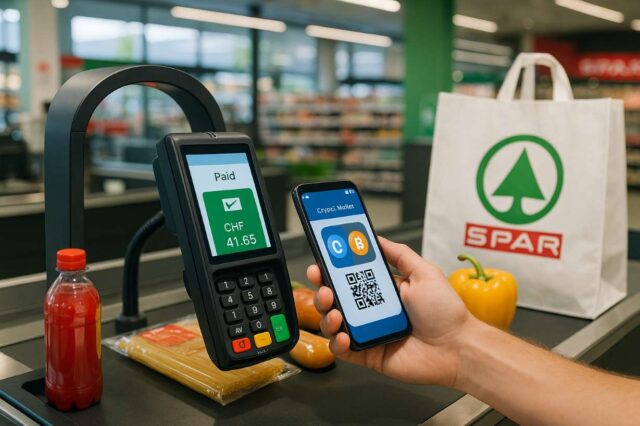
Customer using smartphone to pay with Bitcoin and stablecoins at a SPAR supermarket checkout in Switzerland via QR code, illustrating the nationwide crypto payment rollout.

SPAR Switzerland is taking a bold step into the future of retail by launching crypto payments across its supermarket network. The rollout, powered by Binance Pay and Swiss fintech DFX.swiss, will bring crypto payments to 300 SPAR stores across Switzerland in the coming months. This is one of the largest retail crypto adoption initiatives in the country.

From Bitcoin Pilots to Nationwide Adoption

In April 2025, SPAR tested the concept in two locations, Zug and Kreuzlingen. These branches accepted Bitcoin payments through the Lightning Network, using DFX’s OpenCryptoPay infrastructure. Customers could scan a static QR code at checkout and pay directly from their Bitcoin wallets.

The pilot proved successful. Positive customer feedback and smooth technical performance encouraged SPAR to scale the crypto service. The company is now expanding its crypto checkout to hundreds of supermarkets across the country.

How the Crypto Checkout Works

The system connects directly with Binance Pay Switzerland, giving shoppers access to over 100 cryptocurrencies and stablecoins. Supported options include Bitcoin, Ethereum, and USDT.

  1. At checkout, the POS terminal displays a QR code.
  2. Customers scan it using the Binance Pay app.
  3. They choose their cryptocurrency, and the amount is instantly converted into Swiss francs.

For Bitcoin transactions, Lightning Network payments enable faster processing and lower fees compared to on-chain transfers. This technology ensures a smooth crypto checkout experience for regular shoppers.

Why SPAR Is Betting on Crypto

SPAR Switzerland Managing Director André Scherrer has pointed out that merchants can save up to two-thirds on payment fees compared to credit card transactions. Lower costs, combined with the ability to attract tech-savvy customers, make the move strategically appealing.

Switzerland already has more than 1,000 businesses accepting Bitcoin. Adding Bitcoin payments to everyday grocery shopping at SPAR could make digital currencies far more practical for regular use.

Global and European Context

While this rollout is led by SPAR Switzerland, the brand’s influence reaches far beyond national borders. SPAR International, headquartered in Amsterdam, oversees a global network of nearly 14,000 stores in 48 countries. Its European footprint is particularly strong, with leading market positions in Austria, Italy, Slovenia, Hungary, and Croatia.

This scale makes the Swiss initiative one of the most significant retail crypto integrations in Europe to date. If the model proves successful, it could inspire other SPAR operators and competing supermarket chains to adopt similar crypto checkout systems across multiple countries.

Partnerships Driving the Rollout

  • Binance Pay Switzerland: Provides wallet integration and supports multi-asset payments.
  • DFX.swiss: Manages Bitcoin transactions via the Lightning Network in Switzerland and handles instant fiat conversion.

This setup allows SPAR Switzerland to accept cryptocurrency at checkout without taking on exchange rate risk or managing crypto custody.

What’s Next for SPAR’s Crypto Strategy

Currently, crypto payments are active in 100 stores. The goal is to expand to all 300 targeted locations in the coming months. Although no fixed date has been given, the rollout is progressing steadily.

Some industry watchers are already wondering whether other chains will adopt similar systems, and if SPAR will bring its Swiss supermarket crypto checkout to locations outside Switzerland.

Takeaway

SPAR’s crypto payments rollout in Switzerland is more than a local initiative. Backed by one of the largest supermarket brands globally, it has the potential to influence how digital assets are used in everyday retail across Europe and beyond. By combining Bitcoin payments, stablecoins, and Lightning Network technology, SPAR is positioning itself as both an innovator in the Swiss market and a possible model for global supermarket adoption of crypto.

Readers’ frequently asked questions

Can customers still earn loyalty points when paying with cryptocurrency at SPAR?

Yes. According to SPAR Switzerland, crypto payments are processed like standard card transactions for loyalty purposes, so eligible purchases still earn points.

Are there any extra fees for paying with Bitcoin or other cryptocurrencies in SPAR stores?

No. SPAR states that customers pay the exact converted amount in Swiss francs, with no additional surcharge for using cryptocurrency.

Can customers get a refund in cryptocurrency if they return an item paid for in crypto?

No. Refunds are processed in Swiss francs, regardless of the original payment method.

What Is In It For You? Action items you might want to consider

Test the crypto checkout experience

If you shop at SPAR in Switzerland, try paying with Bitcoin via the Lightning Network or using Binance Pay for altcoins and stablecoins. This will give you first-hand insight into speed, fees, and convenience compared to traditional payment methods.

Compare crypto payments with card loyalty benefits

Since eligible purchases still earn SPAR loyalty points, see if using cryptocurrency offers you the same or better rewards as paying with a bank card, especially when factoring in potential savings on exchange fees.

Track the rollout to additional SPAR stores

Follow SPAR Switzerland’s announcements to know when crypto payments reach more locations. If you live in a city that’s not yet covered, this will help you plan when and where to use digital assets for your grocery shopping.

- Advertisement -

FEATURED