Home Blog Page 93

Do Kwon Pleads Guilty to U.S. Fraud Charges Over $40B Terra Collapse

Cracked “stablecoin” coin beside a gavel on a courthouse table, symbolizing Do Kwon guilty plea in a U.S. fraud case and the TerraUSD/LUNA collapse.

Terraform Labs co-founder Do Kwon has pleaded guilty in the United States to conspiracy to commit wire fraud and securities fraud. The admission comes more than three years after the collapse of the TerraUSD (UST) stablecoin and its sister token LUNA in 2022. The implosion erased an estimated $40–44 billion in market value. It also triggered a chain reaction of bankruptcies and dealt a lasting blow to confidence in the cryptocurrency sector. Do Kwon’s guilty plea closes a long stretch of uncertainty surrounding his criminal exposure in the U.S.

From Algorithmic Darling to Historic Failure

Kwon was once celebrated as a pioneer of algorithmic stablecoins. He promoted UST as a safe, dollar‑pegged asset backed by an innovative mechanism linked to the LUNA token. Prosecutors say these claims were false. The U.S. Department of Justice (DOJ) determined that Kwon and Terraform Labs misled investors about UST’s stability. They also fabricated high‑profile partnerships to make the project appear more credible.

When the peg collapsed in May 2022, both UST and LUNA spiraled downward. In a matter of days, billions of dollars in value disappeared. The crash destabilized the broader digital asset market, forcing several crypto lenders and hedge funds with heavy exposure to shut down.

A Global Manhunt Ends in U.S. Court

Kwon fled South Korea after the collapse, managing to evade authorities for months. In March 2023, he was arrested in Montenegro for traveling with forged documents. He served a local sentence before being extradited to the United States to face federal charges. South Korea has filed its own criminal case. If convicted there, Kwon could face prosecution after completing his U.S. sentence.

The guilty plea represents a sharp reversal for Kwon. For years, he rejected all accusations, describing the TerraUSD collapse as a market failure rather than a deliberate fraud. With his guilty plea now on record, the narrative has shifted from denial to accountability in a U.S. courtroom.

Sentencing Ahead

Sentencing is scheduled for December 2025 in the Southern District of New York. Kwon faces a theoretical maximum penalty of decades in prison. However, plea deals often lead to shorter sentences. The DOJ has stressed that the case shows they will pursue crypto fraud as aggressively as traditional financial crime.

Industry Fallout and Regulatory Implications

The TerraUSD collapse became a turning point for global crypto regulation. Governments accelerated plans for stablecoin oversight and closer monitoring of DeFi projects. In the U.S., lawmakers used the case to push forward stablecoin legislation. South Korean authorities also expanded their capacity to investigate blockchain‑based financial crimes.

For the cryptocurrency industry, Kwon’s guilty plea is a warning. High‑profile failures can bring severe legal consequences. The case also demonstrates that cross‑border cooperation between regulators and prosecutors is becoming the norm. Civil actions and private lawsuits tied to the Terra episode continue in parallel, reinforcing that misconduct in digital assets can trigger accountability on multiple fronts: criminal, regulatory, and investor‑led.

Readers’ frequently asked questions

What happens to Terraform Labs after Do Kwon’s guilty plea?

Terraform Labs is in bankruptcy proceedings in the United States. The company’s assets and liabilities are being reviewed by the court, and ongoing civil actions may impact any remaining operations or asset distributions.

What charges did Do Kwon plead guilty to?

He admitted to conspiracy to commit wire fraud and conspiracy to commit securities fraud in connection with the TerraUSD and LUNA collapse.

Does Do Kwon face charges outside the United States?

Yes. South Korean prosecutors have filed their own criminal case against him, which could proceed after his U.S. sentence is served.

What Is In It For You? Action items you might want to consider

Track sentencing outcome and potential appeals

Kwon’s sentencing in December 2025 could set a precedent for penalties in large-scale crypto fraud cases. Monitor the court’s decision and any subsequent appeal filings to assess their impact on future prosecutions.

Monitor developments in Terraform Labs’ bankruptcy

Asset recovery efforts and creditor claims in Terraform Labs’ bankruptcy could influence investor compensation. Follow court filings and trustee updates to stay informed about possible asset distributions.

Assess regulatory response to the case

Governments are using the TerraUSD collapse as a case study for stronger stablecoin regulation. Traders and blockchain founders should watch for legislative changes in the U.S. and South Korea that may impact project compliance requirements.


Circle Announces Arc: Upcoming USDC-Native Layer-1 Blockchain to Strengthen Stablecoin Infrastructure

Futuristic digital finance hub with glowing USDC symbol and connected blockchain nodes, representing Circle’s upcoming Arc Layer-1 blockchain for stablecoin payments and FX.

Circle has unveiled Arc, an EVM-compatible Layer-1 blockchain purpose-built for stablecoin payments, foreign exchange, and capital markets. The network will utilize USDC as its native gas token and will support sub-second settlement stablecoins. It also includes a stablecoin FX engine for currency conversions and opt-in privacy controls for enterprise users. The public testnet is expected to launch this fall, with mainnet deployment to follow. The announcement comes as legislative frameworks such as the GENIUS Act offer fresh clarity for regulated stablecoins, paving the way for deeper integration into traditional finance.

What is Arc? Planned Technical Features

Circle develops the blockchain to deliver speed, interoperability, and compliance for modern finance. As an EVM-compatible Layer-1 blockchain, it will enable developers to migrate or deploy Ethereum smart contracts while using Arc’s payment-optimized tools.

  • USDC-native gas token – Transactions will be paid in USDC, removing the need for volatile network tokens.
  • Sub-second settlement stablecoins – Targeting finality in under a second for real-time payments, FX trades, and instant remittances.
  • Stablecoin FX engine – Built-in conversion for multiple stablecoin denominations to enable efficient cross-border settlement.
  • Opt-in privacy controls – Planned confidentiality features for enterprises, without undermining compliance requirements.

Strategic Significance for Circle

Arc moves Circle beyond issuing stablecoins. It becomes a provider of enterprise-grade blockchain infrastructure for global payments, FX, and capital markets. Circle is optimizing the network for regulated stablecoins. This will strengthen its influence over the stablecoin value chain while giving institutions a compliance-ready environment for deployment. Ultimately, it increases Circle’s control of the payment stack.

The Circle Arc blockchain also positions USDC as a default settlement asset in both blockchain-based and regulated finance systems. This puts Circle in competition with Layer-1 networks, Layer-2 scaling solutions, and traditional payment processors entering the digital currency space.

Regulatory & Legislative Tailwinds

The timing of Circle’s blockchain announcement aligns with favorable U.S. policy developments. The GENIUS Act offers a defined path for compliant stablecoin operations. This regulatory clarity is expected to boost institutional stablecoin adoption, especially in capital markets settlement, cross-border trade finance, and B2B payments.

Beyond the U.S., Circle is also eyeing expansion into jurisdictions with advanced digital asset regulation, including the EU under MiCA, Hong Kong, and Singapore.

Market Timing & Ecosystem Positioning

Arc’s arrival coincides with strong growth in Circle’s core stablecoin business. The company reported USDC circulation growth of 90% year-over-year, reaching approximately $61 billion in Q2 2025. During the same quarter, Circle posted $658 million in revenue, though it recorded a $482 million net loss tied largely to post-IPO accounting charges.

This post-IPO expansion phase gives Circle the funding and market visibility to promote its Arc blockchain as a settlement and infrastructure layer for global finance. It can position the network to capture more stablecoin payment flows, but also serve as a foundation for institutional capital market applications.

Roadmap & Next Steps

A public testnet is scheduled for this fall, with mainnet launch to follow after developer and enterprise testing. Circle plans to support projects focused on stablecoin payments, FX services using the stablecoin FX engine, and enterprise settlement solutions.

The roadmap also includes onboarding payment processors, banks, and fintech partners to accelerate institutional stablecoin adoption.

Arc is both a technical and strategic milestone for Circle. It combines the flexibility of an EVM-compatible Layer-1 blockchain with the trust of regulated stablecoins. The Circle Arc blockchain could become a core settlement layer for payments, trading, and capital market activity. Powered entirely by USDC as the native gas token.

Readers’ frequently asked questions

What is a “testnet” and why does Arc have one before launch?

A testnet is a separate, trial version of a blockchain used to test features without risking real funds. Arc’s testnet lets developers and enterprises try USDC-based payments, FX conversions, and other functions, and report issues before everything goes live on mainnet.

How is paying fees in USDC different from other blockchains?

Most networks require a native token (e.g., ETH or SOL) for fees. Arc will utilize Circle’s native stablecoin USDC to process gas fees. Businesses won’t need to buy or manage a separate token, which can simplify onboarding and operations.

If Arc is built for institutions, will everyday users benefit?

Yes, but indirectly. Apps built on Circle’s Arc blockchain could power faster, lower-cost payments and remittances for consumers, while settlement and fees happen in USDC behind the scenes.

What Is In It For You? Action items you might want to consider

Follow Arc testnet launch and developer updates

Circle’s public testnet for Arc is planned for fall 2025. Developers, fintech teams, and institutional tech leads should monitor official channels for API documentation, integration guides, and bug bounty opportunities to get early hands-on experience.

Analyze USDC as a network fee model

Arc’s design removes the need for a separate token by using USDC for gas fees. Businesses and payment providers should assess how this could streamline onboarding, reduce volatility risks, and simplify accounting processes compared to other blockchain fee models.

Identify enterprise use cases that benefit from Arc

Institutions working in cross-border payments, FX settlement, and capital markets should explore whether Arc’s speed, integrated FX engine, and opt-in privacy features could improve operational efficiency or compliance alignment in their sector.

Trump’s 401(k) Order Could Bring Crypto and Private Equity to Retirement Menus — What Savers Need to Know

Satirical editorial illustration of a giant Bitcoin and private equity skyscraper being placed into a transparent piggy bank labeled “401(k),” with miniature office workers looking shocked, set against a blurred U.S. Capitol dome, symbolizing Trump’s executive order on alternative assets in retirement plans.

President Donald Trump’s latest executive order aims to allow certain 401(k) alternative investments, including crypto and private equity, in default retirement options. Here’s how the plan works, the risks involved, and when changes could actually take effect.

Executive Order Overview

On August 7, 2025, President Donald Trump signed an executive order directing the Department of Labor (DOL) and the Securities and Exchange Commission (SEC) to craft new rules that would let specific 401(k) funds hold alternative assets, such as cryptocurrencies, private equity, private credit, real estate, commodities, and infrastructure.

The policy applies to default investment options, particularly target-date funds and balanced funds. That’s where the majority of American workers’ retirement savings are allocated by default. The White House describes the move as “democratizing access” to asset classes that have been historically reserved for institutional investors.

Implementation Timeline & Regulatory Process

Despite plenty of headlines about crypto in 401(k) plans, no changes take effect immediately. The executive order launches a 180-day review for the DOL and SEC to update ERISA guidance. They must define fiduciary duty boundaries, and potentially introduce safe-harbor provisions for plan sponsors.

New investment products, such as target-date fund alternatives that feature cryptocurrencies or private equity, would likely not appear until 2026 or later. Implementation will hinge on how regulators address valuation transparency, liquidity constraints, and fee disclosures.

Scale of Potential Impact

The U.S. 401(k) market holds about $9 trillion in assets for nearly 90 million participants. Even a modest 1% allocation to digital assets in default portfolios could drive billions of dollars in potential demand.

For asset managers, the shift could spark development of 401(k) alternative investments that blend public equities, bonds, and alternative sleeves into a single diversified product.

Supporters’ Perspective

Supporters celebrate the diversification of retirement accounts beyond traditional stock-bond mixes. Retail investors could gain exposure to assets with higher-return potential, such as private equity, through new 401(k) strategies. They claim it levels the playing field with institutional investors who already access these markets.

Critics’ Perspective

Critics caution that these new products may incur higher fees compared to index funds. Illiquidity in private markets can limit access to funds during downturns. They also argue that it is much harder to track the true performance of the new funds because valuations are more opaque. The volatility and regulatory uncertainty in the cryptocurrency markets add to the risks. Plan sponsors may expose themselves to legal challenges under ERISA if alternatives underperform.

Market Reaction in the Crypto Sector

Following the announcement, Bitcoin briefly surged, triggering an estimated $300 million in short liquidations before retreating. Obviously, traders assessed the long lead time for implementation.

Analysts note that exchange reserves are at multi-year lows and institutional holdings are rising. These are factors that could amplify price effects if significant 401(k) investment options become available in 2026 to include digital assets.

Parallel “Debanking” Executive Order

Alongside the 401(k) policy, the White House issued a second executive order targeting “politically motivated debanking.” It aims to prevent banks from denying services to lawful industries, including cryptocurrency businesses, based on reputational concerns.

What Savers Need to Know About Crypto in 401(k)

In short, there are no immediate changes. Monitor the DOL and the SEC for updates as they establish new rules. In the meantime, assess your personal risk tolerance for volatile or illiquid investments before you opt in. Even after the rule changes, plan sponsors may choose not to offer these products. Once these new 401(k) alternative investments appear, consult with financial advisors to evaluate whether these options fit with your long-term strategy and goals.

Bottom Line

Trump’s executive order signals a major potential shift in how 401(k) investment options could evolve, introducing assets once reserved for institutional portfolios. The outcome will depend on upcoming rulemaking, market innovation, and whether plan sponsors embrace or reject alternatives like crypto in 401(k) funds.

Until then, the debate over whether these investments belong in default retirement plans is set to dominate both Wall Street and Washington.

Readers’ frequently asked questions

Will my 401(k) automatically invest in crypto or private equity now?

No. The executive order only starts a 180-day review process for the Department of Labor and the SEC to update rules. Any new options must first be approved and added by your plan sponsor.

How would crypto or private equity appear in my 401(k)?

If approved, exposure would most likely come through diversified funds — such as target-date or balanced funds — that include a small percentage of alternative assets, rather than direct purchases of Bitcoin or private equity stakes.

What risks should I know before investing in these assets?

Alternative assets can involve higher fees, limited liquidity, harder-to-value holdings, and — in the case of cryptocurrencies — price volatility. These risks can affect long-term returns and should be weighed carefully before opting in.

What Is In It For You? Action items you might want to consider

Monitor the DOL and SEC rulemaking process

Follow announcements over the next 180 days to understand how regulators will define fiduciary standards and safe-harbor rules for alternative assets in 401(k) plans.

Review your plan’s investment menu

Check if your 401(k) provider or employer offers target-date or balanced funds that might adopt alternative assets once rules change. This will help you prepare for possible new options.

Evaluate your risk tolerance and retirement goals

Before considering allocations to crypto, private equity, or other alternatives, assess how these fit your time horizon, volatility comfort level, and long-term retirement objectives.

Embargo Ransomware: BlackCat’s Heir Targets Healthcare, Rakes in $34M in Crypto

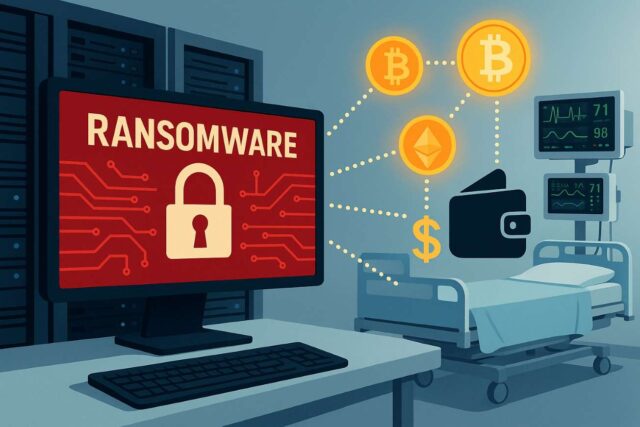
Bright editorial illustration showing a ransomware attack in a hospital setting. A red warning screen with a padlock icon faces a hospital bed and medical monitors, while cryptocurrency symbols and a wallet icon are connected by dotted lines, symbolizing ransom payments in digital currency.

Embargo ransomware has quickly emerged as one of the most dangerous ransomware-as-a-service (RaaS) operations of the past year, amassing $34.2 million in cryptocurrency since April 2024. According to a detailed investigation by blockchain intelligence firm TRM Labs, the group is likely a BlackCat successor. It is reusing the notorious gang’s Rust-based code, laundering techniques, and even ransom note templates.

What makes Embargo stand out is not just its technical background, but its choice of victims. The group crippled hospitals and pharmaceutical networks across the United States with ransomware campaigns in the healthcare sector. The ransom demands reached as high as $1.3 million.

From BlackCat to Embargo: A Familiar Playbook

BlackCat, also known as ALPHV, burst onto the ransomware scene in late 2021. It built its reputation for innovation, large-scale attacks, and one of the first searchable leak portals for stolen data. At its peak in mid-2023, the group was demanding multi-million-dollar payments from critical infrastructure operators worldwide.

In December 2023, the FBI, working with Europol, seized parts of BlackCat’s infrastructure and delivered decryption keys to hundreds of victims. While the takedown was a blow, the group resurfaced briefly before its activity declined sharply in early 2024.

By April 2024, a new player, Embargo ransomware, appeared. Interestingly, researchers quickly noticed overlapping traits:

  • Written in Rust, offering cross-platform capabilities and resistance to reverse-engineering.
  • Leak site design and ransom notes are nearly identical to BlackCat’s.
  • Cryptocurrency wallet activity mirrors BlackCat patterns.

TRM Labs now assesses with high confidence that Embargo is a direct successor of the BlackCat operation under a new brand.

How Embargo Operates

Embargo runs as a ransomware-as-a-service network. That means core operators develop the malware and manage the infrastructure while affiliates conduct attacks for a percentage of the ransom.

Key tactics include:

  • Double extortion — encrypting files and threatening to leak stolen data.
  • AI in ransomware — leveraging machine learning for intrusion detection evasion, phishing optimization, and automated data exfiltration.
  • Advanced defense evasion techniques to bypass endpoint detection and response (EDR) systems.

This combination makes Embargo one of the most technically sophisticated healthcare ransomware actors in operation today. Unfortunately, it’s a prime example of how the double extortion model has evolved to integrate AI-driven enhancements.

Healthcare and Pharmaceuticals in the Crosshairs

While Embargo’s victims span multiple industries, its most visible impact has been on U.S. healthcare and pharmaceutical organizations. Notable incidents include:

  • Memorial Hospital and Manor (Georgia)
  • Weiser Memorial Hospital (Idaho)
  • American Associated Pharmacies

In these attacks, ransom demands have ranged from hundreds of thousands to over $1.3 million, often followed up by threats to leak sensitive patient data. Hospitals are particularly vulnerable because downtime directly impacts patient care, creating intense pressure to pay quickly.

Following the $34 Million Trail

TRM Labs’ blockchain analysis reveals that Embargo has moved approximately $34.2 million in crypto ransom payments through a complex laundering network.

Notable patterns include:

  • Using intermediary wallets to obscure the source of funds.
  • Leveraging sanctioned exchanges such as Cryptex.net.
  • Parking $18.8 million in dormant wallets to avoid immediate detection.

Experts note that this kind of crypto laundering, which combines intermediary wallet hops with jurisdictional arbitrage, is consistent with laundering strategies BlackCat operations used until the 2023 takedown. In fact, Embargo’s methods also illustrate how crypto laundering has become more sophisticated to neutralize blockchain tracing efforts.

Law Enforcement and Industry Response

Cybersecurity experts note that Embargo’s rapid rise underscores the resilience of ransomware networks even after high-profile disruptions. The transition from BlackCat to Embargo highlights how quickly affiliates can regroup under a new banner, reusing infrastructure and tactics.

For healthcare ransomware prevention, analysts recommend:

  • Segmenting networks to limit lateral movement.
  • Implementing multi-factor authentication across all remote access points.
  • Regularly backing up critical systems offline.
  • Training staff to detect phishing attempts.

Law enforcement agencies are monitoring Embargo closely, but the group’s global affiliate structure and crypto laundering practices complicate direct takedown efforts.

Embargo ransomware’s blend of BlackCat’s proven tactics and a targeted focus on healthcare makes it one of today’s most dangerous cyber threats. Despite increased scrutiny by law enforcement, it was able to amass tens of millions in ransom payments within a year. It highlights the adaptability of bad actors and the ransomware-as-a-service model.

The healthcare sector and other high-risk industries are on notice! Ransomware gangs may change names, but their methods, infrastructure, and threat level often remain the same.

Readers’ frequently asked questions

Paying a ransom is not explicitly illegal in many jurisdictions, but it can be unlawful if the payment benefits a sanctioned person or entity. In the U.S., for example, OFAC prohibits transactions with sanctioned wallets or exchanges. Always consult legal counsel and notify law enforcement before making any payment.

How do authorities trace crypto ransom payments?

Investigators use blockchain analytics to follow transactions across public ledgers. Even if attackers route funds through intermediary wallets, mixers, or offshore exchanges, transfers leave a permanent on-chain record. Subpoenas and exchange compliance data can link wallets to real-world identities.

What can healthcare providers do to reduce risk?

Segment critical networks, enforce multi-factor authentication, patch systems promptly, maintain offline/immutable backups, and run regular phishing and incident response drills. Prepare a tested playbook for containment and recovery to minimize downtime if an attack occurs.

What Is In It For You? Action items you might want to consider

Ensure your organization’s ransomware incident response plan includes clear protocols for legal review before any ransom payment is considered. This includes checking for potential sanctions violations and coordinating with law enforcement.

Invest in blockchain transaction monitoring

Adopt blockchain intelligence tools that can track suspicious fund movements and flag wallets linked to ransomware incidents. Early detection can help prevent ransom payments from reaching sanctioned addresses and may aid in recovery efforts.

Prioritize cybersecurity upgrades in high-risk sectors

If you operate in healthcare, pharmaceuticals, or other high-risk industries, focus on implementing offline backups, network segmentation, multi-factor authentication, and regular phishing simulations to mitigate the threat from ransomware-as-a-service groups like Embargo.

Ripple Rail Acquisition: $200M Deal Set to Boost RLUSD Stablecoin and Challenge USDC, USDT

Corporate fintech office with two professionals viewing large digital screens displaying RLUSD stablecoin symbol and global cross-border payment routes in gold and green.

Ripple announced its $200 million acquisition of Rail, marking one of its most ambitious manoeuvres in recent years. The deal will integrate the cross-border payroll and stablecoin payments platform Rail into Ripple’s ecosystem. By doing so, the company aims to accelerate the adoption of the RLUSD stablecoin in enterprise finance and put it in direct competition with leading USDC and USDT stablecoins.

Combining Rail’s compliance-driven infrastructure with Ripple’s existing payments network, the company is betting on a future where regulated stablecoins dominate payroll, remittances, and global B2B transactions. For anyone following Ripple stablecoin news, it’s a clear sign that RLUSD is steadily gaining ground.

A Closer Look at the $200M Ripple Rail Acquisition

This $200 million deal hands Ripple full control of Rail, a Toronto-based fintech known for instant, compliant cross-border payroll and enterprise payment flows. Rail’s API-driven platform enables real-time settlements in multiple currencies, so Ripple plans to extend these capabilities to its RLUSD stablecoin.

RLUSD, launched in December 2024, is a U.S. dollar–pegged, fully regulated stablecoin for institutional and enterprise adoption. By integrating Rail’s infrastructure, Ripple can embed RLUSD instantly into high-volume payment corridors across North America, Europe, and Asia. This move solidifies the acquisition as one of the company’s most strategically timed plays so far.

Why Ripple Is Buying Rail

1. Enterprise Expansion

Rail’s platform gives Ripple direct access to payroll providers, remittance companies, and multinational corporations. This supports Ripple’s enterprise stablecoin adoption strategy.

2. Technology Synergy

Rail’s real-time settlement, compliance automation, and API integration make it a natural fit for Ripple’s payment infrastructure.

3. Global Growth

The deal supports Ripple’s push into regulated jurisdictions, which, in turn, helps build trust with banks, enterprises, and government partners.

Disrupting the Stablecoin Market

Ripple is positioning RLUSD as a competitor to USDC and USDT, specifically built for enterprise-grade use. This is where the stablecoin competition intensifies. Many consumer-facing stablecoins focus predominantly on retail users. RLUSD, on the other hand, is tailored for regulated environments, appealing to organizations that handle payroll or multi-national transactions.

Through Rail, Ripple can embed its stablecoin directly into payment platforms used for salaries, supplier payments, and remittances. Speed, low costs, and strict compliance matter the most in these types of real-world transactions, and RLUSD is designed to deliver all three.

Regulatory and Market Implications

The acquisition also doubles as a regulatory move. As more countries introduce stablecoin frameworks, Ripple wants to be a first-mover in enterprise adoption under compliant structures. Analysts believe this could indeed give Ripple an edge with central banks, financial hubs, and large corporations.

USDC and USDT remain strong in liquidity. However, neither has deep integration into payroll systems. It appears that Ripple may be ready to exploit that gap.

Industry Reactions

  • Fintech analysts highlight the instant scalability RLUSD gains through Rail’s client base.
  • Crypto market watchers see a direct challenge to USDC and USDT competitors in enterprise settlements.
  • Payments insiders suggest other issuers may now seek partnerships with payroll or B2B providers.

What’s Next for Ripple and RLUSD

Ripple says integration will start immediately. Key focus areas include:

  • Payroll for multinational corporations
  • Remittances in high-volume corridors
  • B2B settlement for cross-border trade

If the rollout goes as planned, RLUSD could set the standard for compliant cross-border stablecoin use in enterprise payments and establish a benchmark in the evolving stablecoin market.

Ripple’s Rail acquisition is both a growth strategy and a challenge to the stablecoin status quo. By pairing Rail’s infrastructure with RLUSD, Ripple is scaling its payments network and positioning itself as a leader in regulated stablecoins. In the long term, this move could well make it a challenger to USDC and USDT dominance.

Readers’ frequently asked questions

Will RLUSD be available for individuals to use, or is it only for businesses?

Ripple has positioned RLUSD primarily for institutional and enterprise adoption, but it is tradable on supported exchanges. Individuals can hold and use RLUSD where participating platforms provide access.

What jurisdictions is Rail licensed to operate in?

Rail operates under regulatory approvals in Canada and maintains compliance partnerships to support cross-border payment processing in select international markets.

Does acquiring Rail mean Ripple now needs additional regulatory approvals in other countries?

Yes. Rail’s licenses cover specific regions, but Ripple must meet the regulatory requirements of each jurisdiction where it expands RLUSD-related services.

Does the acquisition give Ripple control over Rail’s existing client contracts?

Yes. The transaction includes Rail’s operational assets and client relationships, giving Ripple control over existing contracts unless limited by particular agreements.

What Is In It For You? Action items you might want to consider

Track RLUSD listings and trading volumes

Keep an eye on exchanges that list RLUSD and monitor its liquidity growth after the Rail acquisition. Rising volumes could indicate increasing institutional adoption and signal potential trading opportunities.

Watch for enterprise partnerships using RLUSD

Follow Ripple’s announcements and industry news for payroll, remittance, or B2B platforms integrating RLUSD. Each confirmed integration could drive demand and strengthen the token’s market position.

Assess the competitive response from USDC and USDT issuers

Stay alert for moves by established stablecoin players to secure new partnerships or enhance enterprise offerings. Their actions could impact RLUSD’s growth trajectory and shape short-term market sentiment.

- Advertisement -

FEATURED