Home Blog Page 96

PayPal’s Crypto Gambit Takes Shape: ‘Pay with Crypto’ Launch Caps Strategic Rollout of Global Payments Network
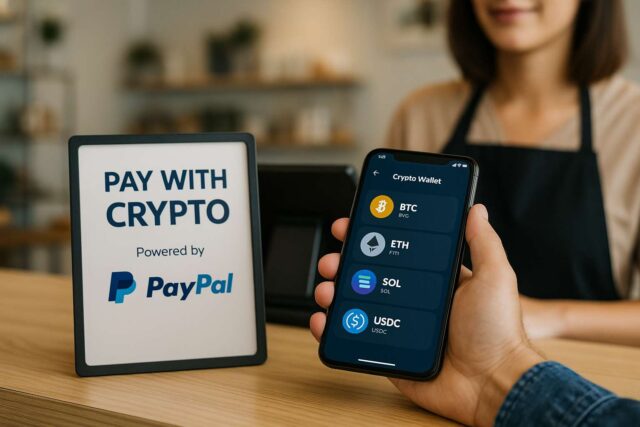
A customer uses a crypto wallet app to pay with Bitcoin, Ethereum, Solana, or USDC at a retail counter featuring a “Pay with Crypto – Powered by PayPal” sign.

PayPal has officially launched its “Pay with Crypto” feature for U.S. merchants. Businesses can now accept over 100 digital assets, including Bitcoin, Ethereum, and Solana, directly at checkout. With real-time settlement into U.S. dollars or PYUSD, the company’s own USD-backed stablecoin, this release marks a turning point in the PayPal crypto strategy. It’s a serious push to move cryptocurrency out of speculative portfolios and into real-world commerce.

The launch comes with a compelling value proposition: a flat 0.99% transaction fee, significantly undercutting traditional card processing costs. Combined with wallet integrations, stablecoin incentives, and cross-chain compatibility, PayPal crypto payments are no longer theoretical. They’re operational.

From Wallet Experiments to Merchant Rails: A Multi-Year Crypto Pivot Comes Full Circle

While the final integrations have come together rapidly in recent months, PayPal’s ambitions in digital assets date back to 2020, when it first enabled users to buy and sell cryptocurrencies like Bitcoin and Ethereum. Over the following years, the company introduced limited checkout features, launched its own PYUSD stablecoin, and quietly secured partnerships and regulatory clarity. Now, with “Pay with Crypto” fully activated for U.S. merchants, PayPal’s multi-year crypto pivot has matured into a full-stack crypto checkout solution. It links users, wallets, and blockchains to real-world commerce.

Recent milestones include:

  • April 2025: PayPal added Solana (SOL) and Chainlink (LINK) to its supported crypto assets for U.S. retail users.
  • Early July: PayPal stablecoin integration expanded to Stellar (cross-border remittances) and Arbitrum (Layer 2 DeFi).
  • July 17: Launch of PayPal World, connecting wallets and fiat partners throughout the world.
  • Mid-July: OKX integration to enable crypto purchases in Europe.
  • July 28: PayPal Pay with Crypto goes live in the U.S., bringing crypto to checkout.

Each step of the rollout prioritized regulatory compliance, technical scalability, and liquidity aggregation before flipping the switch on consumer-facing utility.

PYUSD: The Engine Behind the Checkout Experience

Central to the strategy is PayPal’s PYUSD stablecoin. The USD-pegged digital asset issued by Paxos Trust Company is backed 1:1 by U.S. Treasuries and cash equivalents. PayPal merchants who choose to settle in PYUSD can do so without volatility exposure. Notably, retail users holding PYUSD within PayPal’s ecosystem currently earn a 4% APY yield on their balances.

Unlike many stablecoins limited to a single blockchain, PYUSD is deployed on Ethereum, Arbitrum, and Stellar, allowing it to serve as a settlement rail, rewards asset, and programmable financial instrument across retail and enterprise environments alike.

PYUSD isn’t just a payment token: it’s PayPal’s mechanism for locking in yield, liquidity, and cross-chain stickiness.

For Merchants: Simplicity, Speed, and Savings

The “Pay with Crypto” feature is designed to be invisible to merchants. Businesses don’t need to manage private keys or custody tokens. Instead, customers pay from any major crypto wallet, such as Coinbase, MetaMask, OKX, Phantom, Kraken, or Binance. PayPal handles the on-chain conversion and fiat settlement automatically.

Key features for merchants:

  • Supports 100+ cryptocurrencies
  • Flat 0.99% processing fee
  • Instant conversion to USD or PYUSD
  • No chargeback risk
  • No need to touch crypto directly
  • Accept Bitcoin and Ethereum with PayPal easily, without needing to handle blockchain infrastructure

This rollout allows PayPal merchants to accept crypto with zero technical complexity and minimal financial risk. By undercutting credit card fees (typically 2.5–3.5%) and eliminating foreign exchange headaches, PayPal crypto payments offer a compelling value proposition, especially for small businesses and cross-border e-commerce platforms.

Platform Positioning: PayPal as a Global Settlement Layer

With this launch, PayPal is stepping beyond the role of digital wallet provider and entering a space traditionally taken by card networks, FX brokers, and payment processors.

Its approach is notably chain-agnostic and wallet-inclusive. It allows liquidity to flow from crypto-native environments into merchant-facing infrastructure without forcing users to adopt a new system. Combined with the regulatory green light from the SEC, which recently dropped its probe into PYUSD, PayPal is laying the groundwork for becoming a global fiat-crypto settlement layer.

Where Visa and Mastercard dominate card-based fiat payments, PayPal is positioning itself to own the post-card infrastructure; the invisible pipes that connect crypto, stablecoins, wallets, and regulated commerce.

What Comes Next: Beyond U.S. Borders

Today’s launch is U.S.-only, but the fundamentals are clearly in place for global expansion. With OKX integration in Europe and PYUSD now live on cross-border-friendly chains, PayPal is signaling interest in broader use cases, including:

  • International crypto checkout
  • Enterprise-level programmable payments
  • Recurring or subscription-based stablecoin billing
  • B2B invoice settlements in stablecoins
  • Integration with emerging CBDCs or regional stablecoins

PayPal is also expected to further develop the “PayPal World” platform into a universal payment switchboard, routing fiat and digital assets across partners, rails, and regulatory jurisdictions.

Conclusion: Crypto Infrastructure, Not Hype

The launch of PayPal Pay with Crypto completes PayPal’s transition from offering crypto as a buy-and-hold investment to embedding it into the plumbing of global commerce. Rather than forcing users to learn about wallets or merchants to handle blockchain protocols, PayPal has abstracted the complexity. It created a seamless interface between traditional finance and Web3.

For the first time at scale, crypto is no longer just a speculative asset. It’s a payment option, a settlement layer, and a strategic moat.

Readers’ frequently asked questions

Can any U.S. merchant use PayPal’s “Pay with Crypto” feature?

“Pay with Crypto” is currently available only to merchants based in the United States. Activation in New York State is subject to regulatory approval by the NYDFS.

Do merchants receive crypto or fiat when a customer pays with crypto?

Merchants receive either U.S. dollars or PYUSD. Paypal converts the customer’s cryptocurrency at the point of sale and handles the exchange automatically.

Which wallets and cryptocurrencies are supported at checkout?

Customers can pay using wallets like MetaMask, Coinbase, Binance, Kraken, OKX, Phantom, and Exodus. Over 100 cryptocurrencies are supported, including Bitcoin, Ethereum, USDC, USDT, Solana, and Chainlink.

What Is In It For You? Action items you might want to consider

Evaluate PayPal as a crypto payment gateway for your business

If you’re a U.S.-based merchant or operate an online store, consider whether integrating PayPal’s “Pay with Crypto” feature could reduce your transaction fees and expand your customer base.

Monitor PYUSD adoption across DeFi and cross-border platforms

PayPal’s stablecoin is now live on Ethereum, Arbitrum, and Stellar. Traders and developers should watch how PYUSD is used in DeFi protocols, enterprise settlements, and upcoming cross-border pilot programs.

Track the expansion of PayPal crypto checkout into international markets

Although currently U.S.-only, PayPal’s crypto rollout is expected to expand. Businesses in Europe, Asia, and Latin America should prepare for potential merchant-facing updates and compliance frameworks.


Galaxy Confirms $9B Bitcoin Sale Was Estate Liquidation, Not Panic Dump

Photorealistic image of a gold Bitcoin encased in glass inside a modern server room, symbolizing secure institutional crypto custody and estate liquidation.

What initially triggered fears of a crypto crash has now been clarified. The dramatic Bitcoin price drop to $115,000 this week was not the result of market manipulation or a rogue whale. Instead, the Galaxy Digital $9B Bitcoin sale was a coordinated, institutional-scale estate liquidation involving 80,000 BTC. It ranks among the largest transactions in crypto history.

Galaxy Breaks Silence on the Transaction

Galaxy Digital issued a public statement confirming it facilitated the Bitcoin estate liquidation. The sale was part of a long-term wealth planning process. The firm emphasized that it was not the seller but acted as an intermediary for a Satoshi-era wallet holder.

“Galaxy…today announced the successful execution of one of the largest notional bitcoin transactions in the history of crypto on behalf of a client,” the company said in its official release.

This clarification reframes what was initially reported as a whale sell-off explained by panic. It highlights Galaxy Digital crypto operations and the firm’s growing institutional footprint.

From 17,000 to 80,000 BTC: The Full Picture Emerges

On-chain tracking identified a 17,000 BTC transfer to multiple exchanges, including Binance and OKX. This move caused Bitcoin’s price to dip by about 3%. Galaxy’s confirmation later revealed that this was part of a broader 80,000 BTC transaction valued at over $9 billion.

The coins originated from a Satoshi-era wallet that had been dormant for over 14 years. Their movement sparked concern due to the symbolic weight of such wallets. Early speculation tied the transfer to whale manipulation, but those fears proved unfounded.

How the Market Held Its Ground

Despite the sale’s scale, the Bitcoin price recovery began within 24 hours. BTC rebounded from $115,000 to $117,000. The market absorbed the transaction with surprising stability.

Analysts credited better exchange liquidity and smarter execution. Investor behavior also showed signs of maturity. Unlike earlier episodes of crypto market panic, there were no major liquidations or platform outages. This resilience supports growing confidence in the Bitcoin market’s resilience.

This may mark a turning point in how the market handles large-scale crypto liquidity events. Institutional activity is no longer as disruptive as emotional retail trades.

Panic Was a Narrative — Not a Reality

Initial reports of a whale dump spread quickly. Social media and headlines fueled a familiar wave of panic in the crypto market. Terms like “meltdown” and “collapse” dominated the conversation.

Meanwhile, on-chain analysis worked to identify the wallet’s ownership. But the fear was based on incomplete data. Once the full extent of the Galaxy Digital Bitcoin sale was known, sentiment shifted. The event was not market manipulation but a strategic transaction.

This moment underscores the role of narrative in crypto. It also emphasizes the value of on-chain analysis of BTC whale activity in avoiding rushed conclusions.

Lessons for Investors and Analysts Alike

This event highlights why context matters. For investors, it’s a reminder to verify wallet movements before taking action. Not every Satoshi-era wallet signals bearish intent. Sometimes, it’s just estate planning on a massive scale.

For analysts and journalists, the Galaxy event is a case study in why accuracy matters. Calling every large transfer a “whale dump” misses the nuance of today’s institutional-led crypto economy.

Conclusion: Maturity in the Face of Scale

This Galaxy Digital Bitcoin sale was historic in size but not in impact. The market didn’t crash. It flinched, recalibrated, and then moved forward.

This event indicates an evolution in how cryptocurrency handles major transactions. Infrastructure is stronger. Panic is less reactive. The market is better informed.

When the past reawakens, as it did with this Bitcoin estate liquidation, it no longer means chaos. It means strategy, coordination, and maturity.

Readers’ frequently asked questions

Who owned the Bitcoin involved in the Galaxy sale?

The Bitcoin originated from a long-dormant Satoshi-era wallet. The exact owner remains unknown, but Galaxy Digital confirmed it acted on behalf of an estate as part of a wealth management strategy.

Did Galaxy Digital initiate the sale or just handle execution?

Galaxy Digital did not sell the BTC on its own behalf. It facilitated the transaction as an intermediary, executing a structured sale for a client’s estate over multiple tranches.

Why didn’t this sale crash the crypto market?

Despite the size of the transaction, 80,000 BTC valued at $9B, the market remained stable. Improved exchange liquidity, smarter execution, and a maturing investor base helped absorb the sale without triggering systemic panic.

What Is In It For You? Action items you might want to consider

Use on-chain tools to track dormant whale wallets

Tools like Arkham, Whale Alert, or Lookonchain can help monitor when long-dormant wallets become active. You may spot early signals of large market moves.

Reassess your risk management strategy

Estate-driven sales like this may not always be telegraphed. Traders should regularly update stop-loss settings and price alerts, especially in volatile conditions.

Galaxy Digital’s role as executor, not seller, highlights a growing separation between ownership and execution in crypto. Analysts and investors should follow this shift toward professionalized liquidation.

TOKEN2049 Singapore 2025


TOKEN2049, the world’s largest crypto event, returns to Singapore this October, bringing together 25000+ decision makers to connect, exchange ideas, network, and shape the crypto industry. The two-day event, which will be held at the iconic Marina Bay Sands, promises to be the most ambitious edition yet, welcoming 7000+ companies and C-level executives from 160+ countries.

Why You Shouldn’t Miss TOKEN2049 Singapore 2025

TOKEN2049 goes beyond traditional events. It’s a vibrant intersection of industry visionaries, and the 2025 Singapore edition is no different. With more than 60% of the attendees being C-level executives, TOKEN2049 Singapore 2025 offers an opportunity to meet leading voices who are pioneering blockchain’s next frontier, learn from them, and connect with them.

While the full speaker line-up is yet to be unveiled, we know TOKEN2049 Singapore 2025 will feature 300+ expert speakers, 500+ exhibitors, and 1000+ side events, including the NEXUS Startup Competition. TOKEN2049 NEXUS competition spotlights the most promising early-stage startups from around the globe, offering them platforms to pitch innovative ideas for equity-free rewards, including funds to scale their business, exhibition space at the next TOKEN2049 event, and investment opportunities from NEXUS judges and investors at TOKEN2049.

Who Should Attend TOKEN2049 Singapore 2025

  • Builders and Developers looking to interact and learn from others in the industry and showcase their work.
  • Institutional and Corporate Leaders seeking to gain insights into regulation, tokenization of real-world assets, and AI integration.
  • Investors and VCs looking to meet industry-shaping founders, track nascent tech, and engage in curated networking.
  • Founders and Startups looking to secure funding and learn from industry leaders.
  • Educators and Journalists covering digital assets

Venue and Registration

TOKEN2049 Singapore 2025 will take place at the iconic Marina Bay Sands, Singapore, from 1st to 2nd October 2025. The conference will spread across five floors at the luxurious hotel, with on-site coffee, DJ sets, massages, barbershops, and other exploratory spaces. For information on ticketing, speaker details, or how to become a sponsor, visit their official website.

TOKEN2049 – 2024 Edition Sneak Peek

In 2024, TOKEN2049 Singapore brought together a crowd of over 20000, including 300+ speakers and 400+ exhibitors.

The 2024 speaker line-up:

  • Edward Snowden, a renowned privacy advocate and whistleblower
  • Anatoly Yakovenko, Co-founder of Solana
  • Balaji Srinivasan, serial entrepreneur and futurist
  • Arthur Hayes, CIO of Maelstrom
  • Lando Noris, F1 Driver, McLaren Racing
  • Bryan Johnson, founder of Blueprint, and other top voices in the industry.

Past editions have also featured heavyweights like Vitalik Buterin, the Co-Founder of Ethereum, and Richard Teng, the CEO of Binance.

These appearances speak to TOKEN2049’s role as a stage for serious ideas and serious people. In 2025, that stage only gets bigger. Whether you are looking to invest, build, learn, and be a part of something that defines the future of finance, TOKEN2049 Singapore 2025 is an event not to miss.

Bitcoin Nosedives to $115K After Whale Sell-Off Sparks Panic

Photo-realistic image of a large whale breaching in a stormy ocean beside a digital Bitcoin price display showing $115,000, symbolizing a crypto whale sell-off.

A massive sell-off by a Bitcoin whale has rocked the market. Bitcoin’s price tumbled to a two-week low of $115,000. The dump, estimated at over 17,000 BTC, was facilitated by Galaxy Digital. It sparked fears of deeper volatility and fueled one of the largest single-day BTC price drops in recent months.

Dormant Wallet Awakens After 14 Years

The BTC came from an ancient Bitcoin wallet, dormant for over 14 years. On-chain analysts tracked the transfers and identified the sources as Satoshi-era holdings. Consequently, this revived speculation that long-lost coins were re-entering circulation. The whale wallet activated suddenly and sent the funds to Galaxy Digital.

This rare activity drew comparisons to past dormant coin movements, which historically preceded increased volatility in the crypto market. Therefore, many interpreted the transfer as a high-stakes sell-off by a bitcoin whale rather than a routine fund shuffle.

Coordinated Transfers Shake Markets

In just 12 hours, Galaxy Digital processed a staggering 17,000 BTC transfer and sent the coins to multiple centralized exchanges (CEXs). The rapid distribution suggested a clear intent to liquidate or reallocate a sizable stake. Analysts tracking bitcoin exchange outflows confirmed the wallet spike and CEX inflows.

Almost immediately, the bitcoin price dropped by roughly 3%. This prompted panic selling and sparked online speculation about the origin of the sell-off.

A Flash Crash or a Stress Test?

The sell-off triggered a wave of liquidations. But many analysts pointed to the market’s resilience. “We didn’t see cascading failures,” noted one strategist. “If anything, this shows how much liquidity the market can handle.”

Still, concerns remain. Traders said the BTC market crash triggered stop-loss orders. It also sent shockwaves through altcoin prices. The symbolic nature of an ancient whale wallet, offloading everything, added to the tension.

Galaxy Digital’s Role Under the Spotlight

Galaxy Digital’s bitcoin dump has drawn scrutiny because the firm’s role in institutional crypto transactions is growing. Some wonder if Galaxy acted for a wealthy individual, an early miner, or even an estate.

Despite the drama, Galaxy received a bullish outlook from the investment firm Jefferies. They praised the company for its position at the intersection of crypto infrastructure and AI. The sell-off has not shaken investor confidence in Galaxy.

Community Reactions: Panic or Preparation?

Social media exploded with theories. Some feared market manipulation. Others saw signs of a broader reversal. The event reignited debates about centralization risks and the influence of legacy wallets.

Some retail traders rushed to exit. Others saw the crypto panic selling as an opportunity. “Whales move, weak hands panic” became a recurring sentiment echoed across multiple crypto tweets and forums in response to the event.

What Comes Next for Bitcoin?

The bitcoin whale sell-off exposed fragile market psychology. But it also showed strong liquidity channels. Traders are watching the $110,000 support level for more signals.

Was this dump a one-off or the start of a trend? Either way, crypto has once again reminded us: the past is never truly gone. It can reawaken at any block.

Readers’ frequently asked questions

Who owned the Bitcoin wallet involved in the sell-off?

The exact owner of the wallet remains unknown. On-chain analysis shows the BTC came from a long-dormant wallet inactive for over 14 years, possibly linked to early adopters or miners from the Satoshi era.

Did Galaxy Digital sell the Bitcoin or just facilitate the transfer?

Galaxy Digital is believed to have facilitated the transfer, acting as a custodian or intermediary. There is no confirmed evidence that Galaxy itself initiated the sell-off as a market action.

Was the Bitcoin from this whale wallet linked to any criminal activity or hacks?

No. Blockchain analysis indicates the BTC came from a long-dormant wallet with no known ties to hacks, illicit transactions, or blacklisted addresses. It appears to be a clean early-miner or investor wallet.

What Is In It For You? Action items you might want to consider

Monitor on-chain whale activity

Use platforms like Whale Alert or Arkham to track dormant wallet activations and large BTC transfers to centralized exchanges. These often precede short-term market moves.

Review your stop-loss and price alert settings

A single whale movement triggered a 3% dip. Traders should reassess risk thresholds and automate alerts to stay ahead of sudden volatility.

Evaluate Galaxy Digital’s institutional role

As Galaxy increasingly handles large-scale crypto transfers, it may influence market flows. Investors and crypto analysts might want to follow Galaxy’s custodial, OTC, and treasury activities.

Who’s Losing as Stablecoins Surpass $250B? It’s Not Just Visa and Mastercard

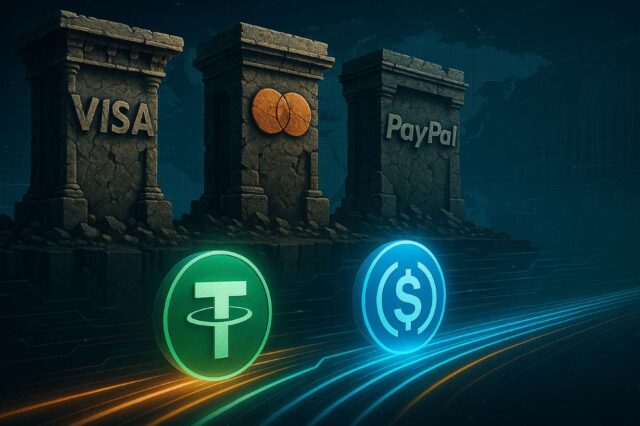
Illustration of crumbling stone pillars labeled Visa, Mastercard, and PayPal above glowing USDT and USDC symbols traveling along digital rails, representing the rise of stablecoin transaction volume over traditional payment networks.

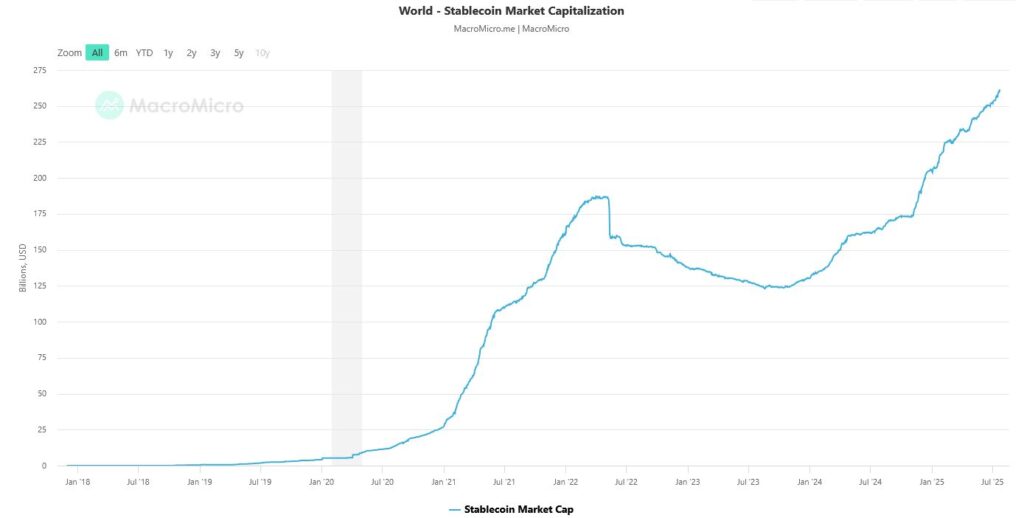
Stablecoins have officially crossed a new threshold, with a combined market capitalization now exceeding $250 billion. This surge in value reflects the expanding role of stablecoins in modern finance. But this number, while impressive, only tells part of the story.

The real disruption is happening beneath the surface, where stablecoin transaction volume now rivals, and in some cases exceeds, the flow processed by traditional payment networks like Visa, Mastercard, and PayPal.

This isn’t just a crypto milestone. It’s a redrawing of the global financial map. Yet despite popular assumptions, the volume that’s shifting onto on-chain rails isn’t coming entirely from credit card companies.

So who’s really losing as stablecoins scale into trillions of dollars in monthly flows?

Stablecoin Market Cap: A Signal, Not the Whole Story

The oft-quoted $250 billion figure refers to the total stablecoin market cap. That’s the aggregate value of tokens like USDT, USDC, and DAI currently in circulation. It represents the size of the “float,” or the total amount of dollar-pegged liquidity available in tokenized form.

Market cap growth is meaningful. It signals institutional trust, broad adoption in fintech and crypto infrastructure, and increasing demand for dollar-denominated digital assets. However, a large market cap doesn’t directly tell us how much economic activity is occurring.

To measure impact, we have to look at stablecoin transaction volume, and that number is far more revealing.

Transaction Volume Tells the Real Story

In 2024, stablecoins processed over $27.6 trillion in total value transfer. As of mid-2025, they’re already pacing ahead of that. Weekly flows now top $500 billion. More than 1 billion on-chain transactions have been recorded in the first half of the year alone.

For context:

  • Visa processes roughly $1.1 trillion per month.
  • Mastercard is close behind.
  • PayPal handles only about $18 billion per month.

This means that on-chain settlement activity in stablecoins now matches or exceeds the volumes of some of the world’s largest payment networks. And yet, these flows are not happening at the point-of-sale.

So Who’s Really Losing Ground?

Contrary to what some headlines suggest, Visa and Mastercard are not the primary victims of rising stablecoin adoption, at least not yet. Their stronghold remains in consumer-facing retail payments: POS terminals, e-commerce checkouts, subscription platforms, and card-linked apps. So far, these flows remain stable.

Instead, the volume that’s shifting on-chain is displacing incumbents in settlement and liquidity infrastructure. Here’s who’s feeling the squeeze:

1. SWIFT & Correspondent Banking Systems

Traditional interbank messaging networks like SWIFT are losing relevance in cross-border payments and corporate treasury transfers. Stablecoins settle in minutes, not days. They eliminate the need to route through multiple banks or jurisdictions. For businesses needing real-time USD liquidity, USDC and USDT are now viable SWIFT alternatives.

2. Money Transfer Operators

Remittance giants like Western Union and MoneyGram have lost volume to mobile-first apps and wallets offering stablecoin remittances. These services are often faster and cheaper. They don’t require a bank account or a physical outlet. Hence, stablecoins are filling gaps left by legacy providers in regions like Latin America, sub-Saharan Africa, and Southeast Asia.

3. ACH and Interbank Settlement Systems

Within domestic markets, especially in the U.S. and Europe, automated clearing houses and batch-based settlement systems are being undercut by stablecoins. Fintechs are increasingly using on-chain settlement rails for B2B transactions, treasury rebalancing, and liquidity pooling. These were tasks previously handled by slow, bank-operated infrastructure.

4. OTC Desks and FX Intermediaries

In capital-constrained economies or inflationary environments, users and businesses are opting for stablecoins over local currency or bank wires. This is reducing demand for high-margin forex services. It also diminishes the role of OTC brokers and foreign exchange desks in facilitating USD access.

Visa and Mastercard: Not Immune, But Still Defended

That’s not to say Visa and Mastercard are untouched. Some digital-native merchant flows, particularly in crypto e-commerce and borderless online platforms, are shifting to stablecoin settlement.

But their core advantage remains intact: brand trust, fraud protection, and consumer rewards. These features still dominate in mainstream retail.

What’s changing, however, is the layer beneath the card swipe. If fintechs, wallets, and platforms increasingly choose to settle balances in stablecoins, traditional networks may no longer control the rails even if they maintain the interface.

A New Financial Infrastructure Is Taking Shape

Stablecoins are particularly attractive in cross-border payments, where they offer speed and efficiency compared to legacy systems.

This shift suggests that stablecoins are becoming foundational to next-generation payment infrastructure, not just speculative tools.

While traditional payment networks still serve the bulk of consumer commerce, their grip on backend settlement is loosening.

The rise of stablecoin transaction volume marks the emergence of an internet-native value layer. From Stripe to Circle, from JPM Coin to PayPal’s own stablecoin, institutions are realizing that programmable money is not a futuristic concept; it’s operational now.

Conclusion: The Settlement War Has Begun

The $250 billion in market cap is a headline number, but the real power lies in the trillions of dollars already flowing through stablecoin rails each month. This isn’t a retail revolt. It’s a structural reconfiguration of the backend systems that underpin global finance.

Visa and Mastercard may still dominate the checkout experience. But the question is: how long will they control the settlement stack beneath it?

Because the shift is already underway, and the transaction volume is voting with its feet.

Readers’ frequently asked questions

How do I actually send money using stablecoins?

To send money, you’ll need a crypto wallet that supports stablecoins like USDT or USDC. Simply enter the recipient’s wallet address and transfer the amount. Transactions usually confirm within seconds and cost a fraction of traditional wire or remittance fees.

Can stablecoins be reversed or refunded if I make a mistake?

No. Stablecoin transfers are irreversible once confirmed on the blockchain. If you send to the wrong wallet address, the funds cannot be recovered unless the recipient returns them voluntarily.

Do stablecoin transfers show up in my bank account?

Stablecoin transactions are recorded on public blockchains but do not appear in your bank account. They are separate from traditional banking infrastructure unless you use an exchange or service that connects both.

What can you do now? Action items to consider

Audit your current cross-border payment workflows

If your business regularly sends money across borders, evaluate how stablecoins (like USDC or USDT) could reduce costs and settlement time compared to SWIFT or traditional banks.

Explore stablecoin settlement APIs or wallets

Fintech teams and payment platforms should test integrations with blockchain-based settlement providers (e.g., Circle, Fireblocks, or Stripe’s USDC pilot) to future-proof infrastructure and speed up treasury operations.

Review regulatory and tax implications

Whether you’re a startup, freelancer, or enterprise, understand how using stablecoins affects your compliance posture. Review reporting rules for digital assets in your jurisdiction and consult a crypto-literate accountant or legal advisor.

- Advertisement -

FEATURED